Thursday, May 14, 2015

STEPHEN HAWKING: COMPUTERS WILL OVERTAKE HUMANS IN 100 YEARS


According to the famous theoretical physicist Stephen Hawking, AI will grow beyond our control sometime in the next century.

“Computers will overtake humans with AI at some within the next 100 years," Hawking said at the Zeitgeist 2015 conference, according to TechWorld. "When that happens, we need to make sure the computers have goals aligned with ours.”

This isn't the first time Hawking has voiced concerns about artificial intelligence. Last December, he told BBC "The development of full artificial intelligence could spell the end of the human race... Humans, who are limited by slow biological evolution, couldn't compete and would be superseded."

With programs like Apple's Siri, our current everyday interaction with AI is still rather minimized and harmless. Still, Hawking says inventors and scientists need to cooperate to control AI advancements for humanity's sake.

Last year, Hawking told Wired "My ideal [film] role would be a baddie in a James Bond film. I think the wheelchair and the computer voice would fit the part." Between that comment and his thoughts on powerful AI, there's definitely a movie plot waiting to be written.


STEPHEN HAWKING: COMPUTERS WILL OVERTAKE HUMANS IN 100 YEARS


According to the famous theoretical physicist Stephen Hawking, AI will grow beyond our control sometime in the next century.

“Computers will overtake humans with AI at some within the next 100 years," Hawking said at the Zeitgeist 2015 conference, according to TechWorld. "When that happens, we need to make sure the computers have goals aligned with ours.”

This isn't the first time Hawking has voiced concerns about artificial intelligence. Last December, he told BBC "The development of full artificial intelligence could spell the end of the human race... Humans, who are limited by slow biological evolution, couldn't compete and would be superseded."

With programs like Apple's Siri, our current everyday interaction with AI is still rather minimized and harmless. Still, Hawking says inventors and scientists need to cooperate to control AI advancements for humanity's sake.

Last year, Hawking told Wired "My ideal [film] role would be a baddie in a James Bond film. I think the wheelchair and the computer voice would fit the part." Between that comment and his thoughts on powerful AI, there's definitely a movie plot waiting to be written.


Tuesday, May 12, 2015

Vietnam's '30 Under 30' Highlight Technology's Potential


Vietnam's '30 Under 30' Highlight Technology's Potential


Taking a group selfie are 30 of the accomplished Vietnamese entrepreneurs under 30 years old highlighted by Forbes. (Lien Hoang for VOA News)

HO CHI MINH CITY—

Vietnam’s future depends on the efforts and priorities of its postwar generation, especially how they apply technology, panelists said at a Forbes summit Tuesday that honored rising stars in technology.

Will young Vietnamese use technology to help their country?

Some at the conference, which marked the first “Forbes Under 30” list of young role models, worried that Vietnamese don't have a nationalist cause, which their parents had during the Vietnam War. The older panelists wondered if young Vietnamese care more about luxury cars and Facebook than helping the country prosper.

“When you live in a peaceful time, you have everything, you have all the opportunity,” former ambassador Ton Nu Thi Ninh said. “But the challenge is, can you identify your dream? If you live in that comfort zone, you don’t know what you can do for your country.”

Accomplished Vietnamese entrepreneurs under 30 years old highlighted by Forbes. (Lien Hoang for VOA News)

At the same time, Ninh and others praised Vietnamese Millennials for their voracious adoption of technology, which makes up a growing share of the economy. Electronics are the nation’s top exports, with corporations from Samsung to Intel turning Vietnam into their production hubs. More than one-third of the country is online, and at least one-fifth has a smartphone.

Many young high tech ‘stars’ in Vietnam

The up-and-comers who are younger than 30 and on the Forbes list include many in the technology and start-up world. Nguyen Ha Dong created the international sensation Flappy Bird, an addictive game played on smartphones, while Pham Le Nguyen co-founded the tech incubator 5Desire, trying to help build the next generation of successful companies.

Each year the U.S. business magazine Forbes profiles young people in various countries seen as the creative and entrepreneurial best of their generation, who are poised to make an impact on the future.

U.S. pop singer Katy Perry, a 30-year-old Goodwill Ambassador for the U.N. Children's Fund, also addressed the gathering, saying she is optimistic for Vietnam's future.

“I’m told you are also the lead generation in innovation, which means you can find solutions that never existed before,” she said.

More than half of Vietnam’s 90 million people are under 30 years old. One who made it onto the Forbes roster is Nguyen Trung Tin, CEO of real estate and tourism company Trung Thuy Group. As a young executive, Tin faces an issue that is magnified in Asia, where age is paramount: many of his staff are older than he is.

“The challenge is, of course, how to learn from those people,” Tin said, “but at the same time how to manage them effectively.”

Young Vietnamese women face some social issues

Some of the women on the Forbes list deal with a different sort of demographic obstacle. Hang Lam Trang Anh, also known as Suboi, the “queen” of hip-hop in Vietnam, said she had to overcome the perception here that rap music is mostly for men, and mostly for black people.

Le Hoang Uyen Vy said that her work came to define her, rather than her marital status. It’s common in Vietnam to ask, “Are you married yet?” rather than, “Are you married?” Vy started the online retailer Chon before she was hired as vice president of VinEcom, an e-commerce site owned by Vietnam’s sole billionaire.

“Before, when friends met me, they’d say, ‘When will you get married?’” Vy said. “But after I joined VinEcom, they asked, ‘How is VinEcom?’ They don’t ask about my marriage life anymore.”

A changed relationship between the US and Vietnam

Also speaking at the summit was U.S. Ambassador Ted Osius, who reminded the audience that this year his country is celebrating 20 years of normalized relations with Vietnam, its onetime war enemy. Many of the Forbes honorees studied in the United States, do business with U.S. partners, or otherwise collaborate with Americans on social, environmental, and other causes.

“The individuals in the inaugural ‘30 Under 30’ list are indicative of these interactions,” Osius said, “and of the strong bilateral relationship that has begun to flourish between the United States and Vietnam.”

Vietnam's '30 Under 30' Highlight Technology's Potential


Vietnam's '30 Under 30' Highlight Technology's Potential


Taking a group selfie are 30 of the accomplished Vietnamese entrepreneurs under 30 years old highlighted by Forbes. (Lien Hoang for VOA News)

HO CHI MINH CITY—

Vietnam’s future depends on the efforts and priorities of its postwar generation, especially how they apply technology, panelists said at a Forbes summit Tuesday that honored rising stars in technology.

Will young Vietnamese use technology to help their country?

Some at the conference, which marked the first “Forbes Under 30” list of young role models, worried that Vietnamese don't have a nationalist cause, which their parents had during the Vietnam War. The older panelists wondered if young Vietnamese care more about luxury cars and Facebook than helping the country prosper.

“When you live in a peaceful time, you have everything, you have all the opportunity,” former ambassador Ton Nu Thi Ninh said. “But the challenge is, can you identify your dream? If you live in that comfort zone, you don’t know what you can do for your country.”

Accomplished Vietnamese entrepreneurs under 30 years old highlighted by Forbes. (Lien Hoang for VOA News)

At the same time, Ninh and others praised Vietnamese Millennials for their voracious adoption of technology, which makes up a growing share of the economy. Electronics are the nation’s top exports, with corporations from Samsung to Intel turning Vietnam into their production hubs. More than one-third of the country is online, and at least one-fifth has a smartphone.

Many young high tech ‘stars’ in Vietnam

The up-and-comers who are younger than 30 and on the Forbes list include many in the technology and start-up world. Nguyen Ha Dong created the international sensation Flappy Bird, an addictive game played on smartphones, while Pham Le Nguyen co-founded the tech incubator 5Desire, trying to help build the next generation of successful companies.

Each year the U.S. business magazine Forbes profiles young people in various countries seen as the creative and entrepreneurial best of their generation, who are poised to make an impact on the future.

U.S. pop singer Katy Perry, a 30-year-old Goodwill Ambassador for the U.N. Children's Fund, also addressed the gathering, saying she is optimistic for Vietnam's future.

“I’m told you are also the lead generation in innovation, which means you can find solutions that never existed before,” she said.

More than half of Vietnam’s 90 million people are under 30 years old. One who made it onto the Forbes roster is Nguyen Trung Tin, CEO of real estate and tourism company Trung Thuy Group. As a young executive, Tin faces an issue that is magnified in Asia, where age is paramount: many of his staff are older than he is.

“The challenge is, of course, how to learn from those people,” Tin said, “but at the same time how to manage them effectively.”

Young Vietnamese women face some social issues

Some of the women on the Forbes list deal with a different sort of demographic obstacle. Hang Lam Trang Anh, also known as Suboi, the “queen” of hip-hop in Vietnam, said she had to overcome the perception here that rap music is mostly for men, and mostly for black people.

Le Hoang Uyen Vy said that her work came to define her, rather than her marital status. It’s common in Vietnam to ask, “Are you married yet?” rather than, “Are you married?” Vy started the online retailer Chon before she was hired as vice president of VinEcom, an e-commerce site owned by Vietnam’s sole billionaire.

“Before, when friends met me, they’d say, ‘When will you get married?’” Vy said. “But after I joined VinEcom, they asked, ‘How is VinEcom?’ They don’t ask about my marriage life anymore.”

A changed relationship between the US and Vietnam

Also speaking at the summit was U.S. Ambassador Ted Osius, who reminded the audience that this year his country is celebrating 20 years of normalized relations with Vietnam, its onetime war enemy. Many of the Forbes honorees studied in the United States, do business with U.S. partners, or otherwise collaborate with Americans on social, environmental, and other causes.

“The individuals in the inaugural ‘30 Under 30’ list are indicative of these interactions,” Osius said, “and of the strong bilateral relationship that has begun to flourish between the United States and Vietnam.”

Google Opens First Asia Campus in High-Tech Seoul


People talk at the entrance to the Google Campus start-up space in the Gangnam district of Seoul, May 8, 2015.

SEOUL—

In Seoul Friday Google opened its first campus in Asia to support Internet start-up entrepreneurs. Google hopes the new venture will give Korean high-tech programs and applications access to the world market, and give Google more access to the Korean market.

Compared to the sprawling complex of buildings and green spaces that make up Google’s main campus and corporate headquarters in California’s Silicon Valley, “Campus Seoul, A Google Space” is a small venture.

Located in an office building in the trendy Gangnam neighborhood, it consists of 2,000 square meters of open office space for Korean Internet entrepreneurs to work.

But Google's expectations for this facility are much bigger than its dimensions. The company wants to make it an incubator for innovation in Asia.

Mary Grove, director of Google for Entrepreneurs says at Campus Seoul, aspiring Internet program developers will get encouragement, mentoring, opportunities to network, and help finding investors. This supportive environment that Google is providing free of charge, she says, also helps the company to penetrate the Korean market.


"Google benefits when start-ups succeed as well. We understand the more start-ups that are created, companies do come on line, use the Internet, use Google, use Google products. It benefits us as well,” said Grove.

First campus in Asia

South Korea is one of the few countries in the world where Google is not the top Internet search engine. Instead the Korean company Naver dominates that market.

Google has similar facilities in London and Tel Aviv, but this is the company’s first such venture in Asia.

In the three years it has been in operation in London the Google campus helped start up companies attract over $110 million in venture capital and create 18,000 new jobs.

One of the Campus Seoul members is April Kim, who started an Internet based translation company called Chatting Cat. She says she likes the workspace and conference areas.

"What’s even better is that they can share information and concerns with other start-ups residing in the campus, and this can be a positive motivation for each other," she said.

Great potential

Google decided on Seoul because it has some of the fastest Internet speeds, a large talent pool of well-educated engineers, and one of the highest percentages of smart phone users in the world.

Jung-min Lim, the director of Campus Seoul says the South Korean government has also made it easier to start new business ventures.

He says a few years ago the South Korean government eliminated many regulations for new businesses and provided policies supporting start-ups.

President Park Geun-Hye was on hand for the opening of Campus Seoul. In 2013 her administration allocated $3 billion to assist new high tech companies grow and compete in the global market.

Google Opens First Asia Campus in High-Tech Seoul


People talk at the entrance to the Google Campus start-up space in the Gangnam district of Seoul, May 8, 2015.

SEOUL—

In Seoul Friday Google opened its first campus in Asia to support Internet start-up entrepreneurs. Google hopes the new venture will give Korean high-tech programs and applications access to the world market, and give Google more access to the Korean market.

Compared to the sprawling complex of buildings and green spaces that make up Google’s main campus and corporate headquarters in California’s Silicon Valley, “Campus Seoul, A Google Space” is a small venture.

Located in an office building in the trendy Gangnam neighborhood, it consists of 2,000 square meters of open office space for Korean Internet entrepreneurs to work.

But Google's expectations for this facility are much bigger than its dimensions. The company wants to make it an incubator for innovation in Asia.

Mary Grove, director of Google for Entrepreneurs says at Campus Seoul, aspiring Internet program developers will get encouragement, mentoring, opportunities to network, and help finding investors. This supportive environment that Google is providing free of charge, she says, also helps the company to penetrate the Korean market.


"Google benefits when start-ups succeed as well. We understand the more start-ups that are created, companies do come on line, use the Internet, use Google, use Google products. It benefits us as well,” said Grove.

First campus in Asia

South Korea is one of the few countries in the world where Google is not the top Internet search engine. Instead the Korean company Naver dominates that market.

Google has similar facilities in London and Tel Aviv, but this is the company’s first such venture in Asia.

In the three years it has been in operation in London the Google campus helped start up companies attract over $110 million in venture capital and create 18,000 new jobs.

One of the Campus Seoul members is April Kim, who started an Internet based translation company called Chatting Cat. She says she likes the workspace and conference areas.

"What’s even better is that they can share information and concerns with other start-ups residing in the campus, and this can be a positive motivation for each other," she said.

Great potential

Google decided on Seoul because it has some of the fastest Internet speeds, a large talent pool of well-educated engineers, and one of the highest percentages of smart phone users in the world.

Jung-min Lim, the director of Campus Seoul says the South Korean government has also made it easier to start new business ventures.

He says a few years ago the South Korean government eliminated many regulations for new businesses and provided policies supporting start-ups.

President Park Geun-Hye was on hand for the opening of Campus Seoul. In 2013 her administration allocated $3 billion to assist new high tech companies grow and compete in the global market.

US Energy Agency Announces Wave Energy Prize Competition


FILE - A man watches ocean waves crash at Seacliff State Beach in Aptos, California.

Sun and wind are seen as the most abundant sources of clean, renewable energy, but as many 'ocean-hugging' countries know, the energy of ocean waves is also both powerful and endless. Looking for the most efficient ways to capture that energy, the U.S. Department of Energy has announced a $1.5 million-prize competition for new ideas.

The department estimates that waves and tides along the U.S. coasts generate 1,420 terawatt-hours of energy annually. That is equal to the output of more than 330 nuclear power plants.

Unfortunately, the efficiency of today’s technologies for capturing that energy is only about 20 percent, too low for the investment to be economical, says Jose Zayas, director of the Wind and Water Power Technologies Office at the Department of Energy.

“We’re really looking to step-change that into the high 30s-40s [percent] and I think… once you achieve that, then the economic competiveness of this industry really comes to life and that’s really the target that we are shooting for,” says Zayas.

To encourage development of new technologies, the Department of Energy has launched a nationwide competition, called the Wave Energy Prize.

Developing new devices to capture wave energy can be a challenge. The environment in which wave capture machines must operate can be very harsh and unforgiving, with crushing blows of notoriously corrosive salty medium.

Competition organizers expect that most of the new ideas will be coming from existing energy companies, but also from the academic sector and research institutions.

Zayas says testing of the proposed technologies will be done in several phases.

“We would have 1/50th scale testing where we would do the first fundamental evaluation of their performance, as well as making sure that they are in a pathway that can assure them success towards a prize. We will then down-select again, and near the end we will have about 10 teams… it’s our hope to be competing at 1/20th scale,” says Zayas.

Testing of the scaled models will be done at the U.S. Navy’s huge indoor testing pool, with machines capable of generating ocean-size waves.

Zayas says the models will not be required to produce electrical power. Instead they will have to prove how much of the wave energy they can capture.

“We are looking at how the companies, architectures, have the ability to capture that energy and, of course, through high degrees of data analysis, acquisition sensing, actually quite easy to convert that mechanical kinetic energy into electrical energy, giving us confidence that at least the attributes of the machine are in line with the objectives of the prize,” says he.

Zayas says the ultimate goal of the Wave Energy Prize is to inspire a new set of power-generating technologies for the 21st century. Developers of the three best performing devices will be awarded prizes ranging from $250,000 to $1.5 million.

US Energy Agency Announces Wave Energy Prize Competition


FILE - A man watches ocean waves crash at Seacliff State Beach in Aptos, California.

Sun and wind are seen as the most abundant sources of clean, renewable energy, but as many 'ocean-hugging' countries know, the energy of ocean waves is also both powerful and endless. Looking for the most efficient ways to capture that energy, the U.S. Department of Energy has announced a $1.5 million-prize competition for new ideas.

The department estimates that waves and tides along the U.S. coasts generate 1,420 terawatt-hours of energy annually. That is equal to the output of more than 330 nuclear power plants.

Unfortunately, the efficiency of today’s technologies for capturing that energy is only about 20 percent, too low for the investment to be economical, says Jose Zayas, director of the Wind and Water Power Technologies Office at the Department of Energy.

“We’re really looking to step-change that into the high 30s-40s [percent] and I think… once you achieve that, then the economic competiveness of this industry really comes to life and that’s really the target that we are shooting for,” says Zayas.

To encourage development of new technologies, the Department of Energy has launched a nationwide competition, called the Wave Energy Prize.

Developing new devices to capture wave energy can be a challenge. The environment in which wave capture machines must operate can be very harsh and unforgiving, with crushing blows of notoriously corrosive salty medium.

Competition organizers expect that most of the new ideas will be coming from existing energy companies, but also from the academic sector and research institutions.

Zayas says testing of the proposed technologies will be done in several phases.

“We would have 1/50th scale testing where we would do the first fundamental evaluation of their performance, as well as making sure that they are in a pathway that can assure them success towards a prize. We will then down-select again, and near the end we will have about 10 teams… it’s our hope to be competing at 1/20th scale,” says Zayas.

Testing of the scaled models will be done at the U.S. Navy’s huge indoor testing pool, with machines capable of generating ocean-size waves.

Zayas says the models will not be required to produce electrical power. Instead they will have to prove how much of the wave energy they can capture.

“We are looking at how the companies, architectures, have the ability to capture that energy and, of course, through high degrees of data analysis, acquisition sensing, actually quite easy to convert that mechanical kinetic energy into electrical energy, giving us confidence that at least the attributes of the machine are in line with the objectives of the prize,” says he.

Zayas says the ultimate goal of the Wave Energy Prize is to inspire a new set of power-generating technologies for the 21st century. Developers of the three best performing devices will be awarded prizes ranging from $250,000 to $1.5 million.

Proper Forest Management Is a Key to Feeding Planet

Forests can help to reduce hunger and improve nutrition for millions of people, according to a major report released at the United Nations.

The world population is expected to climb to 9 billion by 2050. By that time the demand for food will double. Accommodating those future needs is a concern today, especially for the more than 800 million people who go to bed hungry.

In its report, the International Union of Forest Research Organizations (IUFRO), the world’s largest network of forest scientists, notes that healthy forests provide half the fresh fruit we consume. They produce valuable commodities like coffee, avocados, cashews and other seeds popular on the world market.

Harvested buritis, a wild fruit from the tropical rainforest in Brazil. (Credit: Neil Palmer/CIFOR)

The products are also rich in vitamins, proteins and other nutrients. The iron content of dried seeds of the African locust bean and raw cashew nut are comparable with, or even higher than, that of chicken meat, the report says.

Tree foods can also be a safety net for people living in and around the forest, said Bhaskar Vira, director of the University of Cambridge Conservation Research Institute and chairman of the IUFRO panel that wrote the report.

He compared it to an insurance policy. “Having access to tree-based foods is hugely important when you can’t buy food from other sources or when you can’t produce food because your fields have failed,” he said.

Complementary activities

Yet agriculture is a major driver of deforestation. Vira said the two can co-exist, even complement each other, if managed properly.

“The neglect of those forest foods is one of the reasons why people are willing to clear them and convert them over to agriculture," he said. "We are arguing that you should think about that landscape as a much more integrated production landscape.”

Agricultural yields in one place, Vira added, can free up other areas to retain trees and the products and services they provide.

What keeps people hungry is often not lack of food, but lack of access to that food and control over its production, Vira said. “When people have greater control over the resources, forest health, its economic value and the lives of the people improve,” he said.
Farmer Yaw Obeng of Ghana with cooking fat made from Allanblackia seeds. (Credit: World Agro Forestry Centre/Charlie Pye-Smith)

Take, for example, the locally managed agro-forestry project in Ghana where people hope to reap profits from Allanblackia, a fruit-bearing plant. The oil from its seed can be used in soaps, beauty products and food. According to project coordinator Okai Michael Henchard, communities "get additional income. They get trees on their land. It provides shade to [understory crops] and then collectively we restore the land.”

“Allanblackia also sequesters carbon,” he added, “so it is helping to fight climate change.”

'Vigilant' about resource use

Vira cautioned that overharvest can bring ruin. “We don’t want to be in a situation where we are overexploiting this resource and then reducing its long-term sustainability," he said. "So we have to be quite vigilant, especially when you get market value imposed on these commodities and the desire for short-term profitability sometimes competing with the long-term sustainability of the resource.”

The report underscores the importance of reimagining forested and agricultural landscapes through careful management and good governance. Vira said that approach, if done right, can help alleviate hunger and poverty worldwide.

Sixty scientists from around the world collaborated on the publication,Forests, Trees, Landscapes for Food Security and Nutrition, A Global Access Report.

Proper Forest Management Is a Key to Feeding Planet

Forests can help to reduce hunger and improve nutrition for millions of people, according to a major report released at the United Nations.

The world population is expected to climb to 9 billion by 2050. By that time the demand for food will double. Accommodating those future needs is a concern today, especially for the more than 800 million people who go to bed hungry.

In its report, the International Union of Forest Research Organizations (IUFRO), the world’s largest network of forest scientists, notes that healthy forests provide half the fresh fruit we consume. They produce valuable commodities like coffee, avocados, cashews and other seeds popular on the world market.

Harvested buritis, a wild fruit from the tropical rainforest in Brazil. (Credit: Neil Palmer/CIFOR)

The products are also rich in vitamins, proteins and other nutrients. The iron content of dried seeds of the African locust bean and raw cashew nut are comparable with, or even higher than, that of chicken meat, the report says.

Tree foods can also be a safety net for people living in and around the forest, said Bhaskar Vira, director of the University of Cambridge Conservation Research Institute and chairman of the IUFRO panel that wrote the report.

He compared it to an insurance policy. “Having access to tree-based foods is hugely important when you can’t buy food from other sources or when you can’t produce food because your fields have failed,” he said.

Complementary activities

Yet agriculture is a major driver of deforestation. Vira said the two can co-exist, even complement each other, if managed properly.

“The neglect of those forest foods is one of the reasons why people are willing to clear them and convert them over to agriculture," he said. "We are arguing that you should think about that landscape as a much more integrated production landscape.”

Agricultural yields in one place, Vira added, can free up other areas to retain trees and the products and services they provide.

What keeps people hungry is often not lack of food, but lack of access to that food and control over its production, Vira said. “When people have greater control over the resources, forest health, its economic value and the lives of the people improve,” he said.
Farmer Yaw Obeng of Ghana with cooking fat made from Allanblackia seeds. (Credit: World Agro Forestry Centre/Charlie Pye-Smith)

Take, for example, the locally managed agro-forestry project in Ghana where people hope to reap profits from Allanblackia, a fruit-bearing plant. The oil from its seed can be used in soaps, beauty products and food. According to project coordinator Okai Michael Henchard, communities "get additional income. They get trees on their land. It provides shade to [understory crops] and then collectively we restore the land.”

“Allanblackia also sequesters carbon,” he added, “so it is helping to fight climate change.”

'Vigilant' about resource use

Vira cautioned that overharvest can bring ruin. “We don’t want to be in a situation where we are overexploiting this resource and then reducing its long-term sustainability," he said. "So we have to be quite vigilant, especially when you get market value imposed on these commodities and the desire for short-term profitability sometimes competing with the long-term sustainability of the resource.”

The report underscores the importance of reimagining forested and agricultural landscapes through careful management and good governance. Vira said that approach, if done right, can help alleviate hunger and poverty worldwide.

Sixty scientists from around the world collaborated on the publication,Forests, Trees, Landscapes for Food Security and Nutrition, A Global Access Report.

US Survey Says Afghan Drug Users Nearly Doubled Since 2012


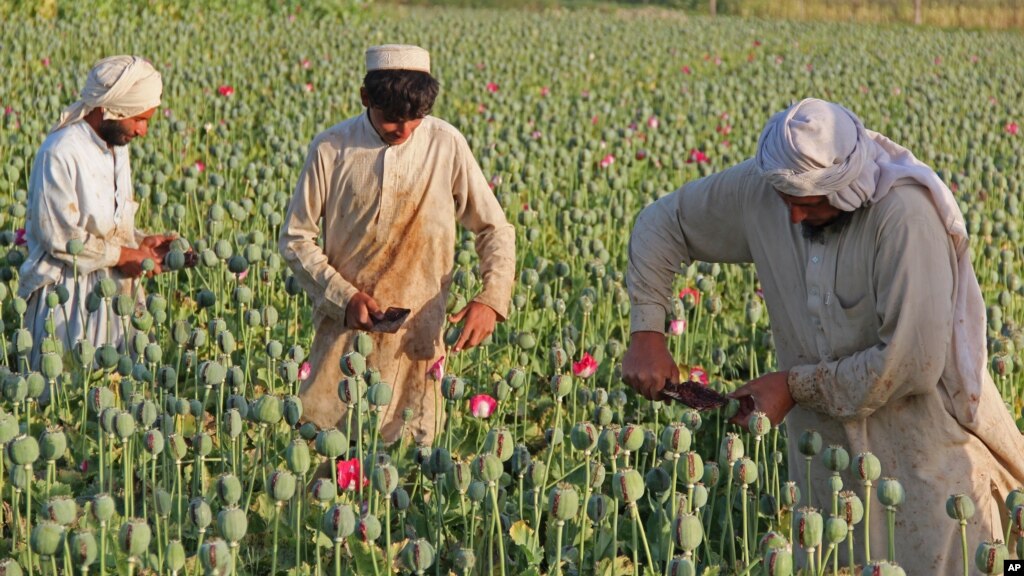
Afghan farmers collect raw opium as they work in a poppy field in Chaparhar district of Jalalabad, east of Kabul.

A survey reveals that the number of drug users in Afghanistan increased to three million last year from an estimated 1.6 million in 2012.

Afghan Health Minister Ferozuddin Feroz, while releasing findings of the U.S.-funded study in Kabul Tuesday, said it shows an alarming increase in drug users both in cities and rural areas, with children and women among them.

He said the number of drug users across Afghanistan stood at around 900,000 in 2005.

However, the survey has since documented the number of drug users increased to three million in 2014, the minister added, terming the trend “very worrying.”

Visiting Assistant Secretary of State for the Bureau of International Narcotics and Law Enforcement Affairs, William Brownfield, while sharing results of the research study, said it tells a “disturbing” story.

“Even more disturbing, the survey suggests that opioids, which lead to heroin and opium, the most disturbing of all the drugs, are the most prevalently used drugs in the rural area," Brownfield said, adding that children are also affected by this drug use.

The survey showed a national drug use rate of 11 percent, one of the highest in the world, suggesting one in every nine Afghans is a user of drugs.

"Drug use is an Afghan problem, an American problem and a problem for all the 195 countries represented in the United Nations," Brownfield said, underscoring the need for Afghans to tackle the issue as a national problem, and not a foreign problem.

The U.N. estimates Afghanistan grows about 80 percent of the world’s opium, which is used to produce highly addictive heroin. The war-torn country accounts for 90 percent of the world’s heroin supply
.

US Survey Says Afghan Drug Users Nearly Doubled Since 2012


Afghan farmers collect raw opium as they work in a poppy field in Chaparhar district of Jalalabad, east of Kabul.

A survey reveals that the number of drug users in Afghanistan increased to three million last year from an estimated 1.6 million in 2012.

Afghan Health Minister Ferozuddin Feroz, while releasing findings of the U.S.-funded study in Kabul Tuesday, said it shows an alarming increase in drug users both in cities and rural areas, with children and women among them.

He said the number of drug users across Afghanistan stood at around 900,000 in 2005.

However, the survey has since documented the number of drug users increased to three million in 2014, the minister added, terming the trend “very worrying.”

Visiting Assistant Secretary of State for the Bureau of International Narcotics and Law Enforcement Affairs, William Brownfield, while sharing results of the research study, said it tells a “disturbing” story.

“Even more disturbing, the survey suggests that opioids, which lead to heroin and opium, the most disturbing of all the drugs, are the most prevalently used drugs in the rural area," Brownfield said, adding that children are also affected by this drug use.

The survey showed a national drug use rate of 11 percent, one of the highest in the world, suggesting one in every nine Afghans is a user of drugs.

"Drug use is an Afghan problem, an American problem and a problem for all the 195 countries represented in the United Nations," Brownfield said, underscoring the need for Afghans to tackle the issue as a national problem, and not a foreign problem.

The U.N. estimates Afghanistan grows about 80 percent of the world’s opium, which is used to produce highly addictive heroin. The war-torn country accounts for 90 percent of the world’s heroin supply
.

Monday, May 11, 2015

ARAB WOMEN: HIGHLY EDUCATED, UNDEREMPLOYED


If you were asked to name countries where women vastly outnumber men in higher education, somewhere in the ultra-traditional Arab world would probably not be your first guess. And yet, in tiny Qatar, the oil-rich peninsula jutting off Saudi Arabia into the Persian Gulf, nearly seven times as many women as men are enrolled in university, one of the highest rates on the planet, according to the most recent figures compiled by the World Bank.

In fact, Maysa Jalbout, a fellow at the Brookings Institution’s Center for Universal Education, calculated recently that across the Arab world, women slightly outnumber men in tertiary education, with
a female-to-male enrollment ratio of 108 percent.

Surprisingly, it’s not a brand-new trend. Paolo Verme, a World Bank expert on the Middle East and North Africa, tells OZY that women there have made “huge gains” in the last decade or so in obtaining secondary and tertiary education. Fertility rates have also gone down rapidly across the region in the 21st century. And GDP growth has been on the rise. These are all prerequisites for women entering the workplace, at least based on what economists have found from studying other countries that now have high levels of female employment. So if all of this is happening in Arab countries, why are there still so few women working there?

As Jalbout points out, “Three out of four Arab women remain outside the labor force” — the lowest in the world. That’s true whether they’re college graduates or relatively uneducated. In fact, Verme and two colleagues found that in Morocco, the likelihood of women having a job went down with a high school-level education. He thinks there are a couple different factors at play.

The first is economic — the economies in the region may be growing, but not in the sectors most likely to employ women, like services and light manufacturing. And then there are the social norms. Verme has found that women in the region may get jobs early on, but exit the labor force en masse around the age of 25, aka average marriage age, regardless of whether or not they have children then. Family structures, still quite traditional, have a lot to do with it, says Mayyada Abu-Jaber, founder of the Jordan-based education NGO The World of Letters. In her work conducting youth employment-training programs, she found that more than half of female participants would decline the jobs offered upon completion. Deciding to work was a “collective decision of the family,” she found, and most families decide the vocational job opportunities “are not desirable for women.”

And while norms have shifted when it comes to the value of educating girls, they’ve not yet hit the women’s lib end of the spectrum. Education, notes Abu-Jabber, is now “very important for women” in Jordan, but not as a “transition for the workplace as much as it is becoming more desirable for marriage.” That helps explain why women with secondary education are less likely to work — they’re more likely to marry an educated man with a job that can support them both.

Verme cautions against concluding this all goes back to Muslim society. Look at the high female employment in places like Indonesia or Malaysia, which are majority Muslim. She says gender norms and social structure issues are important to the extent that the economy is weak. “I’m convinced if a country like Morocco was really able to compete in light manufacturing globally, all these other constraints would progressively disappear.”


Top Image Source: Loizeau/CC


OZY AUTHOR EMILY CADEI

Emily covers government, world affairs, business and sports for OZY. California-bred and D.C.-based, she's reported from four of the world's seven continents — still waiting for a byline from South America, Australia and Antarctica!

ARAB WOMEN: HIGHLY EDUCATED, UNDEREMPLOYED


If you were asked to name countries where women vastly outnumber men in higher education, somewhere in the ultra-traditional Arab world would probably not be your first guess. And yet, in tiny Qatar, the oil-rich peninsula jutting off Saudi Arabia into the Persian Gulf, nearly seven times as many women as men are enrolled in university, one of the highest rates on the planet, according to the most recent figures compiled by the World Bank.

In fact, Maysa Jalbout, a fellow at the Brookings Institution’s Center for Universal Education, calculated recently that across the Arab world, women slightly outnumber men in tertiary education, with
a female-to-male enrollment ratio of 108 percent.

Surprisingly, it’s not a brand-new trend. Paolo Verme, a World Bank expert on the Middle East and North Africa, tells OZY that women there have made “huge gains” in the last decade or so in obtaining secondary and tertiary education. Fertility rates have also gone down rapidly across the region in the 21st century. And GDP growth has been on the rise. These are all prerequisites for women entering the workplace, at least based on what economists have found from studying other countries that now have high levels of female employment. So if all of this is happening in Arab countries, why are there still so few women working there?

As Jalbout points out, “Three out of four Arab women remain outside the labor force” — the lowest in the world. That’s true whether they’re college graduates or relatively uneducated. In fact, Verme and two colleagues found that in Morocco, the likelihood of women having a job went down with a high school-level education. He thinks there are a couple different factors at play.

The first is economic — the economies in the region may be growing, but not in the sectors most likely to employ women, like services and light manufacturing. And then there are the social norms. Verme has found that women in the region may get jobs early on, but exit the labor force en masse around the age of 25, aka average marriage age, regardless of whether or not they have children then. Family structures, still quite traditional, have a lot to do with it, says Mayyada Abu-Jaber, founder of the Jordan-based education NGO The World of Letters. In her work conducting youth employment-training programs, she found that more than half of female participants would decline the jobs offered upon completion. Deciding to work was a “collective decision of the family,” she found, and most families decide the vocational job opportunities “are not desirable for women.”

And while norms have shifted when it comes to the value of educating girls, they’ve not yet hit the women’s lib end of the spectrum. Education, notes Abu-Jabber, is now “very important for women” in Jordan, but not as a “transition for the workplace as much as it is becoming more desirable for marriage.” That helps explain why women with secondary education are less likely to work — they’re more likely to marry an educated man with a job that can support them both.

Verme cautions against concluding this all goes back to Muslim society. Look at the high female employment in places like Indonesia or Malaysia, which are majority Muslim. She says gender norms and social structure issues are important to the extent that the economy is weak. “I’m convinced if a country like Morocco was really able to compete in light manufacturing globally, all these other constraints would progressively disappear.”


Top Image Source: Loizeau/CC


OZY AUTHOR EMILY CADEI

Emily covers government, world affairs, business and sports for OZY. California-bred and D.C.-based, she's reported from four of the world's seven continents — still waiting for a byline from South America, Australia and Antarctica!

A BANKER TURNED WRITER KNOWS MYTHOLOGY IS HOT

Picture this: You’re a private banker and a mother to two excitable boys. You decide it’s time for your kids to hear the stories you grew up listening to. You visit bookstores, seeking children’s versions of the mythological epics that enraptured you as a child. Nothing satisfies. What do you do?

If you’re Bhakti Mathur, you write the damn book yourself.

At 42, Mathur — a Hong Kong–based investment banker — is the author of the popularAmma, Tell Me series, sold in six countries. The books introduce children between the ages of 3 and 9 to Hindu mythology. That’s no easy task: Those myths, like their Greek or Roman counterparts, number in the hundreds of thousands, with no shortage of gods (with multiple names, no less). In the lead-up to the publication of her ninth book, Mathur earned an invite to this year’s Jaipur Literature Festival, the largest free festival in the world.


Bhakti Mathur.

Source: Bhaktimathur.Com

Funnily, though, Mathur’s writing venture could not have had a humbler start. She self-published her first book, Amma, Tell Me About Holi! She knew zilch about logistics and found herself running to the post office to courier one book at a time to readers. Thank god(s) for her banking background, which made her more competent at the biz side than your average creative. And that biz side may be surprisingly fruitful in India, where there’s a huge market for modern kids’ books that retell classics. Mythology is hot, says Reena Puri, executive editor of Amar Chitra Katha, a comic-book publisher that, thanks to colorful, straightforward storytelling about gods and goddesses, has sold millions of books worldwide since the company’s inception in 1967. Not to mention the diaspora — Mathur has lived in San Francisco and Hong Kong — where anxious parents find themselves hankering for a tangible way to transmit the old country’s values. More than a third of Mathur’s total sales are from the U.S.

Mathur’s work fits into a controversial zeitgeist in which Hindu stories have become political.

Why all the fuss about old epics? “Ours is a living mythology; the gods in the books are there on our altars,” says Puri (and on calendars, in rickshaws, in films, on television, etc.). And then there’s a modern explanation. Harry Potter, Lord of the Rings — “confusing fantasy (nobody’s truth) with mythology (a culture’s truth) is quite common,” says Devdutt Pattanaik, one of India’s most prolific mythologists. There’s also an impetus to revive Indian cultural history that under colonialism went unwritten for years. For Amma to tell of festivals like Holi and Diwali or epics like the Ramayana is for Amma to preserve rather a lot of culture.

Mathur’s love for Hindu mythology started young. An only child from a middle-class family, she often felt an outsider in her prep school. The best part of her day was spent after school with her caretaker, a kindly old man who regaled her with stories from the Hindu epics. Lost in the world of mighty kings, learned sages, fearsome demons and the gods incarnate, she floated into contentedness. It’s odd, hearing a banker talking about magical creatures with such excitement. More so, when you see slim, bright-eyed, professional-looking Mathur in action. While talking to her, you can almost feel her brain whirring — making lists, taking notes and generally filing away information to ponder over later. It’s evident that research really is her favorite part of writing, as she had claimed in our first conversation.

Thanks to the “lingering sense of insecurity” over her childhood financial situation, she ended up in banking. “Is there anyone whose dream is to become a banker?” she says, laughing. Armed with a master’s degree in finance, she moved to Mumbai from New Delhi in 1995 for her first job, where she met her husband. Two years later, they were married — but within a week of the wedding, the company declared bankruptcy and her husband lost his job. They headed to San Francisco five years later; then Hong Kong.

Mathur’s reach is limited — she has sold only 85,000 copies, which isn’t bad in the tight Indian market, but a pittance globally. One reason could be that her books offer only a surface understanding of the subject. They are great pictorially and as an introduction — definitely better suited for a youngster of 3 than 9 — but if you’re hoping to familiarize your child with the finer details of the stories that make up Hinduism, you’re going to be a tad disappointed. And Hindu mythology is itself “tough to understand,” says Pattanaik.

Another interesting wrinkle: Mathur’s work fits into a controversial zeitgeist in which Hindu stories have become political — the ruling conservative party has been accused of deploying them selectively, and a cohort of mostly Western scholars sought to create a comprehensive library to gather the poorly recorded Hindu classics. The wrong portrayal of Hinduism, in the eyes of some right-wingers, is enough for a book to be banned (as University of Chicago professor Wendy Doniger’s The Hindus: An Alternate History was) or to incite protest.

Mathur figures she’s far from the politics, though, and begins first and foremost with the reactions of her sons, who serve as her guinea pigs. They’re not always pleased. Recently, her son Shiv grew angry with his mother when he discovered she was not actually the author of the Ramayana. “‘You copied him?’” she recalls her son asking. “I’m still not sure if he’s forgiven me.”


SONALI KOKRA

OZY AUTHOR

Sonali Kokra is a journalist and writer living in Mumbai.

A BANKER TURNED WRITER KNOWS MYTHOLOGY IS HOT

Picture this: You’re a private banker and a mother to two excitable boys. You decide it’s time for your kids to hear the stories you grew up listening to. You visit bookstores, seeking children’s versions of the mythological epics that enraptured you as a child. Nothing satisfies. What do you do?

If you’re Bhakti Mathur, you write the damn book yourself.

At 42, Mathur — a Hong Kong–based investment banker — is the author of the popularAmma, Tell Me series, sold in six countries. The books introduce children between the ages of 3 and 9 to Hindu mythology. That’s no easy task: Those myths, like their Greek or Roman counterparts, number in the hundreds of thousands, with no shortage of gods (with multiple names, no less). In the lead-up to the publication of her ninth book, Mathur earned an invite to this year’s Jaipur Literature Festival, the largest free festival in the world.


Bhakti Mathur.

Source: Bhaktimathur.Com

Funnily, though, Mathur’s writing venture could not have had a humbler start. She self-published her first book, Amma, Tell Me About Holi! She knew zilch about logistics and found herself running to the post office to courier one book at a time to readers. Thank god(s) for her banking background, which made her more competent at the biz side than your average creative. And that biz side may be surprisingly fruitful in India, where there’s a huge market for modern kids’ books that retell classics. Mythology is hot, says Reena Puri, executive editor of Amar Chitra Katha, a comic-book publisher that, thanks to colorful, straightforward storytelling about gods and goddesses, has sold millions of books worldwide since the company’s inception in 1967. Not to mention the diaspora — Mathur has lived in San Francisco and Hong Kong — where anxious parents find themselves hankering for a tangible way to transmit the old country’s values. More than a third of Mathur’s total sales are from the U.S.

Mathur’s work fits into a controversial zeitgeist in which Hindu stories have become political.

Why all the fuss about old epics? “Ours is a living mythology; the gods in the books are there on our altars,” says Puri (and on calendars, in rickshaws, in films, on television, etc.). And then there’s a modern explanation. Harry Potter, Lord of the Rings — “confusing fantasy (nobody’s truth) with mythology (a culture’s truth) is quite common,” says Devdutt Pattanaik, one of India’s most prolific mythologists. There’s also an impetus to revive Indian cultural history that under colonialism went unwritten for years. For Amma to tell of festivals like Holi and Diwali or epics like the Ramayana is for Amma to preserve rather a lot of culture.

Mathur’s love for Hindu mythology started young. An only child from a middle-class family, she often felt an outsider in her prep school. The best part of her day was spent after school with her caretaker, a kindly old man who regaled her with stories from the Hindu epics. Lost in the world of mighty kings, learned sages, fearsome demons and the gods incarnate, she floated into contentedness. It’s odd, hearing a banker talking about magical creatures with such excitement. More so, when you see slim, bright-eyed, professional-looking Mathur in action. While talking to her, you can almost feel her brain whirring — making lists, taking notes and generally filing away information to ponder over later. It’s evident that research really is her favorite part of writing, as she had claimed in our first conversation.

Thanks to the “lingering sense of insecurity” over her childhood financial situation, she ended up in banking. “Is there anyone whose dream is to become a banker?” she says, laughing. Armed with a master’s degree in finance, she moved to Mumbai from New Delhi in 1995 for her first job, where she met her husband. Two years later, they were married — but within a week of the wedding, the company declared bankruptcy and her husband lost his job. They headed to San Francisco five years later; then Hong Kong.

Mathur’s reach is limited — she has sold only 85,000 copies, which isn’t bad in the tight Indian market, but a pittance globally. One reason could be that her books offer only a surface understanding of the subject. They are great pictorially and as an introduction — definitely better suited for a youngster of 3 than 9 — but if you’re hoping to familiarize your child with the finer details of the stories that make up Hinduism, you’re going to be a tad disappointed. And Hindu mythology is itself “tough to understand,” says Pattanaik.

Another interesting wrinkle: Mathur’s work fits into a controversial zeitgeist in which Hindu stories have become political — the ruling conservative party has been accused of deploying them selectively, and a cohort of mostly Western scholars sought to create a comprehensive library to gather the poorly recorded Hindu classics. The wrong portrayal of Hinduism, in the eyes of some right-wingers, is enough for a book to be banned (as University of Chicago professor Wendy Doniger’s The Hindus: An Alternate History was) or to incite protest.

Mathur figures she’s far from the politics, though, and begins first and foremost with the reactions of her sons, who serve as her guinea pigs. They’re not always pleased. Recently, her son Shiv grew angry with his mother when he discovered she was not actually the author of the Ramayana. “‘You copied him?’” she recalls her son asking. “I’m still not sure if he’s forgiven me.”


SONALI KOKRA

OZY AUTHOR

Sonali Kokra is a journalist and writer living in Mumbai.

WWII POW Remembers Allied Victory in Europe


May 8 marks 70 years since the Allied victory in Europe in World War II, but memories are still strong for one veteran who almost didn’t survive the war’s end.

Merle Hancock was one of 16 million men who fought in the Second World War, and almost was one of those who didn’t make it home.

As he looks at the planes that will fly in the 70th V-E Day anniversary commemoration, Merle remembers being drafted at age 19.

"[I had] never been on an aircraft before, and let alone, hold on to a gun – that was frightening to the death," recalled Hancock.

Merle joined the 10-man crew of a B-17 plane that flew bombing runs over Germany.

"We were signed to a B-17, and from there on our life was the B-17. We slept together, we ate together, we went to town together. We didn’t do anything unless we were all together," he said.

In unheated planes flying high over enemy territory, attacked by bombs, machine guns and heavy antiaircraft fire, Merle and the crew survived 36 missions.

That all changed during their 37th mission.

"We lost 17 B-17s that day – 10 men to a ship."

Merle personally shot down three German fighter planes before parachuting out of his burning B-17.

He landed in what must have been the highest tree in Germany, he said, only to be captured and turned over to the Gestapo.

They interrogated him and sent him to Stalag Luft Camp IV – a German prisoner of war camp.

With the Allies pushing toward victory, the Germans marched the prisoners out of the camp.

"We lost about 2,000 men on that march. I call it a march – it was a walk of survival," Merle said.

The end of hostilities in Europe came May 8, 1945, after six long years of war.

Marched almost to death, Merle didn’t experience V-E Day like the rest of the world.

"The greatest thing that happened is when I was liberated, and I don’t remember joy or anything like that, I don’t remember that, probably did but maybe we were too hungry to jump," he recalled.

As Europe celebrated, Merle worried about simpler things.

"I had my first shower and my first hot meal in about a year. The shower was great and the meal was good," he said.

The U.S. military recognized Merle’s contributions with a Silver Star and a Purple Heart.

"The day the two-star general pinned [these] on me, I cried," he said. The medals were pinned on his shirt once again for the commemoration.

Of the 16 million men who went to war, about 1 million are still alive for the 70th anniversary.

WWII POW Remembers Allied Victory in Europe


May 8 marks 70 years since the Allied victory in Europe in World War II, but memories are still strong for one veteran who almost didn’t survive the war’s end.

Merle Hancock was one of 16 million men who fought in the Second World War, and almost was one of those who didn’t make it home.

As he looks at the planes that will fly in the 70th V-E Day anniversary commemoration, Merle remembers being drafted at age 19.

"[I had] never been on an aircraft before, and let alone, hold on to a gun – that was frightening to the death," recalled Hancock.

Merle joined the 10-man crew of a B-17 plane that flew bombing runs over Germany.

"We were signed to a B-17, and from there on our life was the B-17. We slept together, we ate together, we went to town together. We didn’t do anything unless we were all together," he said.

In unheated planes flying high over enemy territory, attacked by bombs, machine guns and heavy antiaircraft fire, Merle and the crew survived 36 missions.

That all changed during their 37th mission.

"We lost 17 B-17s that day – 10 men to a ship."

Merle personally shot down three German fighter planes before parachuting out of his burning B-17.

He landed in what must have been the highest tree in Germany, he said, only to be captured and turned over to the Gestapo.

They interrogated him and sent him to Stalag Luft Camp IV – a German prisoner of war camp.

With the Allies pushing toward victory, the Germans marched the prisoners out of the camp.

"We lost about 2,000 men on that march. I call it a march – it was a walk of survival," Merle said.

The end of hostilities in Europe came May 8, 1945, after six long years of war.

Marched almost to death, Merle didn’t experience V-E Day like the rest of the world.

"The greatest thing that happened is when I was liberated, and I don’t remember joy or anything like that, I don’t remember that, probably did but maybe we were too hungry to jump," he recalled.

As Europe celebrated, Merle worried about simpler things.

"I had my first shower and my first hot meal in about a year. The shower was great and the meal was good," he said.

The U.S. military recognized Merle’s contributions with a Silver Star and a Purple Heart.

"The day the two-star general pinned [these] on me, I cried," he said. The medals were pinned on his shirt once again for the commemoration.

Of the 16 million men who went to war, about 1 million are still alive for the 70th anniversary.

Friday, May 8, 2015

Capitalism vs. lock in


Free markets encourage organizations to take leaps, to improve products, to obsess about delighting customers. One reason that this happens is that competition is always nipping at your heels... if you don't get better, your clients will find someone who does.

But once lock-in occurs, the incentives change. When the cost of switching gets high enough, the goals of the business (particularly if it is a public company) start to drift.

Google doesn't need to make search more effective. They seek to make each search more profitable instead.

Apple doesn't need to obsess about making their software more elegant. They work to make the platform more profitable now.

[For example, iMovie, which has destroyed all possible competitors because of lock-in pricing, but continues to badly disappoint most reviewers.]

Verizon doesn't need to make its broadband faster or more reliable. Just more profitable.

In many ways, it's more urgent than ever to engage in free market competitive thinking when you start a small business. But as network effects increase, we're getting worse at figuring out what to do about restoring free markets at the other end of the spectrum, at places where choices aren't as free as they used to be.

We all benefit when organizations that believe they have lock-in act like they don't.

Capitalism vs. lock in


Free markets encourage organizations to take leaps, to improve products, to obsess about delighting customers. One reason that this happens is that competition is always nipping at your heels... if you don't get better, your clients will find someone who does.

But once lock-in occurs, the incentives change. When the cost of switching gets high enough, the goals of the business (particularly if it is a public company) start to drift.

Google doesn't need to make search more effective. They seek to make each search more profitable instead.

Apple doesn't need to obsess about making their software more elegant. They work to make the platform more profitable now.

[For example, iMovie, which has destroyed all possible competitors because of lock-in pricing, but continues to badly disappoint most reviewers.]

Verizon doesn't need to make its broadband faster or more reliable. Just more profitable.

In many ways, it's more urgent than ever to engage in free market competitive thinking when you start a small business. But as network effects increase, we're getting worse at figuring out what to do about restoring free markets at the other end of the spectrum, at places where choices aren't as free as they used to be.

We all benefit when organizations that believe they have lock-in act like they don't.

SELFAA is ready to come in 2026