Monday, May 18, 2015

Life & Death inPashupati

I do not like to take the easy way. I love to be lost. To explore again places that may seem familiar. So even on my fifty-first visit to the ancient temple of Pashupati, I find myself uncovering new mysteries and exploring hidden corners.

GMB Akash ·
Pashupati Temple, Kathmandu, Nepal

This place is very well-known to me. I have been here fifty times, and my camera has captured every memory from each of my visits. Yet even in its familiarity, there remains much to explore. And so once more, it is to the mystical temple of Pashupati — on the banks of the Bagmati River in Kathmandu — that I am headed for my fifty-first visit.
In one glance the place seems like it has taken a shower with morning glow. The magma-tinted light may never have been as vivid as it is now.

The magnetic aromas from a nearby shop and the many flowers waiting on stands are always a welcome sign for the tourists. In the side mirror of my taxi, I see buses full of the Indian community queuing behind us. The temple is dedicated to a manifestation of Shiva called Pashupati (Lord of the Animals) and attracts many thousands of devout pilgrims every year.


I do not like to take the easy way. I love to be lost. So on this visit, I did not enter the temple grounds in the usual way. Instead I went to the Dharmashila — a stone on the south side of the temple where sacred oaths are taken, and there are pillars with statues of Shah kings. Today many families have made space for themselves in the yard under the open air. They are tribal Indians who visit Pashupati once a year.
There were married women of all ages wearing anklets and a ring on the middle toe of their dark-toned feet. As I was taking a picture of a woman, I saw her burn the ‘roti’ that was in her pan. One of her hungry children grabbed it quickly before the other four siblings could take it.

They do not understand Hindi, Nepali or English. Their children yell and their tired faces reflect how far they have come. I left them to struggle with their rotis and looked for my next place.


Entering the temple, I could see once more the giant and impossible temple soaring above me. As I walked inside, I could hear the rhythmic chanting and the sounds of bells ringing in the distance.
Before I could even inhale the smoke and tart air a group of people suddenly appeared saying, “Hari, Hari.” They were part of a funeral, going down to the riverside. Drawn to their group, I started to follow.

The cries of the women echoed on the walls, and made the atmosphere heavier. Even the monkeys who were throwing papers at people stopped for a while. I saw a woman faint as she went to give water to her dead mother, whose body has been ritually placed.


Down by the river, there were three more of the deceased being prepared for their eternal ritual. It is tough to have the mental balance to take photographs in such moments. Having sympathy for the family while taking pictures at the same time is the toughest.

In this time of great grief nobody concerned themselves with me or my camera and I started taking pictures as if I was an invisible person. No one looked at me or asked me to leave, and so I continued to capture their tender and painful moments of farewell.


When I no more can bear the pain of the grieving relatives who keep crying out in anguish in an unknown language, I leave the temple.

After walking a while I meet my familiar priests. They are always the same year after year. Their posture, ornaments, and clothes always remain the same. As usual, the Hanuman with his mobile phone inside his box and the naked Sadhu are all in their customary places. One of them says loudly, with a smile, “Bangladeshi Akash, kaise hat?”


After a while the smell of a different fragrance comes along, so I start to follow it. With every visit I have discovered more mysteries of Pashupati Temple. ‘Pashu’ means living beings, and ‘Pati’ means master. Translated literally, Pashupati is the master of all living beings in the universe.

This time I went directly to the hindu cremation ghat. The same old fragrance welcomed me. Flames from fire, smoke and ashes were all around. Relatives of the dead were sitting inside and outside the temple.

One of the deceased was ready for the final ritual and, after having his head shaved and carefully placing the wood, his bereaved son set it alight. The man’s relatives were holding holy texts and kept chanting.


The sound of spitting fire and wood kept haunting me, the fire sending ashes all over my body. After two or three hours, only ashes remained.
As the steps were being prepared for another cremation I watched young children in the river below, collecting the charred wood that had been discarded after the ritual ceremony.

The kids mostly come from outside the Kathmandu Valley and live near the Pashupati Arya Ghat so that they can regularly collect the half-burnt wood to sell to nearby brick factories. After a while, one of the Dhakal asked me not to take pictures any more, so I put away my camera.


As the day drew to a close, the sun was going away, perhaps taking with it all the remaining souls. In the temple religious music was playing. In this holy place, in the midst of all this loss, some people keep seeking life.
Life and death are entwined incredibly closely with one and other at Pashupati Temple, and maybe that is why it is so special.


Sunday, May 17, 2015

Ends of the Earth


Over the course of just 24 days, I found myself traveling to three of the most extreme locations on the planet. We explored a fiery volcanic lake in the Congo, a retreating glacier that hangs above a rainforest in New Zealand, and a murky, ethereal underwater sinkhole in Mexico.

Over the course of just 24 days, I found myself traveling to three of the most unique locations on the planet, crossing 24 timezones, 10 countries, and 5 continents. Sponsored by Casio, the expedition’s aim was to showcase their newest watch’s strength and accuracy under adverse conditions, while I photographed the natural beauty of three of the world’s most extreme environments, each with its own set of challenging conditions.

Our journey began on the Yucatán peninsula, where we descended into a flooded cave system, known as a cenote, to capture a mysterious underwater world. From there, we set out for New Zealand’s South Island to document the fragile, frozen landscapes of the Tasman and Fox glaciers.

The active Congolese volcano, Mount Nyiragongo, provided our expedition with its final and most foreboding location. Towering above dense jungle in a former warzone, the jagged ridge of Nyiragongo’s crater offers a view into the world’s largest open lava lake.


I. Mexico
CENOTE ANGELITA

On the Yucatán peninsula in Mexico, the jungle is full of deep holes or ‘cenotes’ as they are called. Linked together by subterranean cave systems and underwater tunnels that have been created over millennia, a cenote is a natural pit, or sinkhole, resulting from the collapse of the limestone bedrock, which exposes the groundwater underneath.
We travelled to the region to explore the Angelita Cenote, a mysterious watery underworld shrouded in sulphuric clouds, and punctuated with dead trees and the deposits of the thick jungle that surrounds its rim.


From the surface of the cenote you cannot see the bottom, and if Mordor had a swimming pool, this is what it would look like.

As you descend an island of mud and leaves emerges, with dead trees sticking up. This island is surrounded by an eerie, yet alluring, underwater cloud of green hydrogen sulphide that sits at 27 metres down. It is an incredible experience to see this strange underwater environment, and the Angelita Cenote looks evil in a very beautiful way.


II. New Zealand
FOX GLACIER

In total there are more than 3,000 glaciers in New Zealand of various size and shape, the majority of which are located near the Main Divide of the Southern Alps on the South Island.

Globally, there are more than 300,000 glaciers and yet only two of those descend into temperate rainforest. One of these is the Fox glacier in New Zealand, and which reaches rainforest only 300 meters above sea level.
One of the most impressive aspects of this glacier is the juxtaposition between the steely glacial ice and lush vegetation nearby — the rainforest sits just beneath the retreating glacier. It is the world’s natural beauty at its best.


To get to a good viewing point we headed up a track that had been officially closed due to flood damage, so our team clambered over rocks, boulders and trees to reach a ridge surrounded by tree ferns and other vegetation, with the Fox glacier looking majestic in the background.
A stunning, and worrisome, example of glacial retreat, Fox Glacier was in full retreat for over a century, then advanced between 1985 and 2009, but is now back into full retreat.


III. The Congo
MOUNT NYIRAGONGO

There are many reasons why one probably shouldn’t go to Democratic Republic of the Congo — the security situation in eastern DRC remains ‘unstable’, which is government jargon for an area rife with armed groups, armed rebels, and bandits, many of whom are known to kill, rape, kidnap, pillage, steal vehicles, and to carry out military or paramilitary operations in which civilians and foreigners can be indiscriminately targeted.


However, the DRC also has one of the most amazing environments on the planet in Virunga National Park. Only one other place in the world hosts the majestic mountain gorillas who have been protected since the park was established in 1925 as Africa’s first national park. Designated as a UNESCO World Heritage Site since 1979 the park is back in the hands of the The Congolese Institute for Nature Conservation (ICCN).
Soaring 3,470 meters above sea level in Virunga National Park is Mount Nyiragongo. An active stratovolcano, it cradles the world’s largest open lava lake at the base of its impressive main crater.

There have been 34 recorded eruptions since 1882, and the most recent eruption in 2002 saw lava flow down the valley into the city of Goma with devastating consequences, slicing the city in half and leaving more than 120,000 homeless.


Reaching the crater involves a six or seven hour hike up to the windy and cold ridge, and we experienced close to freezing temperatures at night.

As it gets darker the glow of the lava intensifies. Just before sunrise, in the moments when the sun and moon swap places on the horizon, Nyiragongo is lit by the glow of molten magma. In a unique natural phenomenon, it becomes possible to simultaneously photograph the red hot lava and the crater itself, illuminated by the blue hues of dawn.


Photographing on the ridge of a volcano has its own challenges — our tripods had to be secured with ropes, we all wore harnesses when looking down the almost vertical 300 m drop, and we had to beware the dangerous gas emissions as we got closer to the molten lava.
The Nyiragongo crater is a truly amazing sight, but the fact that it is remote and located in a conflict zone certainly made our access to the volcano complicated. It is a rare privilege to have visited this place.

Source:
https://maptia.com/klausthymann/stories/ends-of-the-earth 


Ends of the Earth


Over the course of just 24 days, I found myself traveling to three of the most extreme locations on the planet. We explored a fiery volcanic lake in the Congo, a retreating glacier that hangs above a rainforest in New Zealand, and a murky, ethereal underwater sinkhole in Mexico.

Over the course of just 24 days, I found myself traveling to three of the most unique locations on the planet, crossing 24 timezones, 10 countries, and 5 continents. Sponsored by Casio, the expedition’s aim was to showcase their newest watch’s strength and accuracy under adverse conditions, while I photographed the natural beauty of three of the world’s most extreme environments, each with its own set of challenging conditions.

Our journey began on the Yucatán peninsula, where we descended into a flooded cave system, known as a cenote, to capture a mysterious underwater world. From there, we set out for New Zealand’s South Island to document the fragile, frozen landscapes of the Tasman and Fox glaciers.

The active Congolese volcano, Mount Nyiragongo, provided our expedition with its final and most foreboding location. Towering above dense jungle in a former warzone, the jagged ridge of Nyiragongo’s crater offers a view into the world’s largest open lava lake.


I. Mexico
CENOTE ANGELITA

On the Yucatán peninsula in Mexico, the jungle is full of deep holes or ‘cenotes’ as they are called. Linked together by subterranean cave systems and underwater tunnels that have been created over millennia, a cenote is a natural pit, or sinkhole, resulting from the collapse of the limestone bedrock, which exposes the groundwater underneath.
We travelled to the region to explore the Angelita Cenote, a mysterious watery underworld shrouded in sulphuric clouds, and punctuated with dead trees and the deposits of the thick jungle that surrounds its rim.


From the surface of the cenote you cannot see the bottom, and if Mordor had a swimming pool, this is what it would look like.

As you descend an island of mud and leaves emerges, with dead trees sticking up. This island is surrounded by an eerie, yet alluring, underwater cloud of green hydrogen sulphide that sits at 27 metres down. It is an incredible experience to see this strange underwater environment, and the Angelita Cenote looks evil in a very beautiful way.


II. New Zealand
FOX GLACIER

In total there are more than 3,000 glaciers in New Zealand of various size and shape, the majority of which are located near the Main Divide of the Southern Alps on the South Island.

Globally, there are more than 300,000 glaciers and yet only two of those descend into temperate rainforest. One of these is the Fox glacier in New Zealand, and which reaches rainforest only 300 meters above sea level.
One of the most impressive aspects of this glacier is the juxtaposition between the steely glacial ice and lush vegetation nearby — the rainforest sits just beneath the retreating glacier. It is the world’s natural beauty at its best.


To get to a good viewing point we headed up a track that had been officially closed due to flood damage, so our team clambered over rocks, boulders and trees to reach a ridge surrounded by tree ferns and other vegetation, with the Fox glacier looking majestic in the background.
A stunning, and worrisome, example of glacial retreat, Fox Glacier was in full retreat for over a century, then advanced between 1985 and 2009, but is now back into full retreat.


III. The Congo
MOUNT NYIRAGONGO

There are many reasons why one probably shouldn’t go to Democratic Republic of the Congo — the security situation in eastern DRC remains ‘unstable’, which is government jargon for an area rife with armed groups, armed rebels, and bandits, many of whom are known to kill, rape, kidnap, pillage, steal vehicles, and to carry out military or paramilitary operations in which civilians and foreigners can be indiscriminately targeted.


However, the DRC also has one of the most amazing environments on the planet in Virunga National Park. Only one other place in the world hosts the majestic mountain gorillas who have been protected since the park was established in 1925 as Africa’s first national park. Designated as a UNESCO World Heritage Site since 1979 the park is back in the hands of the The Congolese Institute for Nature Conservation (ICCN).
Soaring 3,470 meters above sea level in Virunga National Park is Mount Nyiragongo. An active stratovolcano, it cradles the world’s largest open lava lake at the base of its impressive main crater.

There have been 34 recorded eruptions since 1882, and the most recent eruption in 2002 saw lava flow down the valley into the city of Goma with devastating consequences, slicing the city in half and leaving more than 120,000 homeless.


Reaching the crater involves a six or seven hour hike up to the windy and cold ridge, and we experienced close to freezing temperatures at night.

As it gets darker the glow of the lava intensifies. Just before sunrise, in the moments when the sun and moon swap places on the horizon, Nyiragongo is lit by the glow of molten magma. In a unique natural phenomenon, it becomes possible to simultaneously photograph the red hot lava and the crater itself, illuminated by the blue hues of dawn.


Photographing on the ridge of a volcano has its own challenges — our tripods had to be secured with ropes, we all wore harnesses when looking down the almost vertical 300 m drop, and we had to beware the dangerous gas emissions as we got closer to the molten lava.
The Nyiragongo crater is a truly amazing sight, but the fact that it is remote and located in a conflict zone certainly made our access to the volcano complicated. It is a rare privilege to have visited this place.

Source:
https://maptia.com/klausthymann/stories/ends-of-the-earth 


E. Africa Rangers Go High-tech Against Poachers

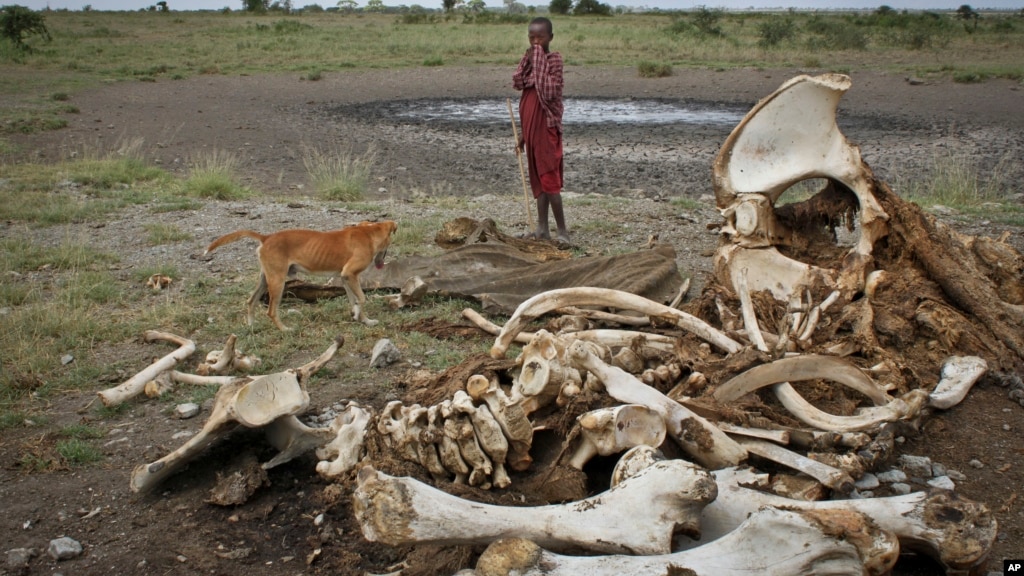
FILE - A Maasai boy and his dog stand near the skeleton of an elephant killed by poachers outside of Arusha, Tanzania.


Conservationists struggling to track down and prosecute poachers hunting for rhino horn, ivory and bush meat are turning to new technologies like DNA identification and surveillance drones to give them an edge in the war on poaching.

Africa’s fight against poaching is often described as a war. The slaughter is on the rise, fueled by growing Asian demand for ivory and rhino horn. Experts estimate more than 35,000 African elephants are killed every year. Rhino poaching is thought to have reached record levels.

Faced with such formidable foes, African conservationists no longer rely on simple foot patrols. This is a modern war and it is becoming increasingly high-tech.

Several weeks ago, a small white airplane, the DT26, took to the skies over the Selous Game Reserve in Tanzania. The plane is an unmanned aerial vehicle, or drone, and its designers hope it will soon be used to catch poachers.

Mike Chambers runs Bathawk Recon, the company that made the drone. He said right now, Tanzania’s embattled rangers do not have the resources to even keep up with poachers.

“With a quarter of a million square kilometers of protected area, it’s impossible with the budget that Tanzania has to cover that area effectively," he said. "Resources available to rangers just aren’t going to be able to do it, especially at the moment, where the resources for poachers are rising because of the international demand.”

His drones, he said, can patrol vast swathes of territory that would be otherwise impossible to monitor. It is a technological solution that lets manpower be deployed more effectively. He hopes it will give park authorities the upper hand.

“Drones give a multiplier effect to rangers," he said. "If we can cover four or five thousand square kilometers with a pod of drones, then fewer rangers are needed to cover that area because they can be organized as a reaction force, and go where we have found the incidents to be occurring.”

In neighboring Kenya, the wildlife service is focusing on cutting edge genetics to strengthen legal cases against poachers. Earlier this month, they opened a forensics and genetics lab in Nairobi, where suspected bushmeat can be identified.

Philip Muruthi of the African Wildlife Foundation said along with ivory poaching, illegal bushmeat hunting is also cutting into Kenya’s wildlife population, but until now prosecuting perpetrators has been difficult. Poachers often claim giraffe or zebra meat is beef, said Muruthi, and it can be hard to prove otherwise.

“Often law enforcers in the wildlife area lose their cases because they cannot authenticate," he said. "They can’t prove in a court of law that that which they are using as an exhibit is actually prohibited wildlife material.”

The new lab should be able to tell the difference. But Muruthi said it will also build a genetic database of Kenya’s endangered animals that should help prosecute ivory and rhino horn poachers as well.

“When you find samples from anywhere in the world you can take those samples and match them to your database, and be able to say where the confiscated item comes from," he added. "So if you are trying to nail somebody in a court of law, you can say, ‘well, this is something that you are trafficking illegally.’”

Conservationists point out that technology is only as good as the people behind it, and that Africa’s endangered animals still depend on the political will to protect them — which, they say, is sometimes lacking.

If this war is to be won, it will take the best tools available.

E. Africa Rangers Go High-tech Against Poachers

FILE - A Maasai boy and his dog stand near the skeleton of an elephant killed by poachers outside of Arusha, Tanzania.


Conservationists struggling to track down and prosecute poachers hunting for rhino horn, ivory and bush meat are turning to new technologies like DNA identification and surveillance drones to give them an edge in the war on poaching.

Africa’s fight against poaching is often described as a war. The slaughter is on the rise, fueled by growing Asian demand for ivory and rhino horn. Experts estimate more than 35,000 African elephants are killed every year. Rhino poaching is thought to have reached record levels.

Faced with such formidable foes, African conservationists no longer rely on simple foot patrols. This is a modern war and it is becoming increasingly high-tech.

Several weeks ago, a small white airplane, the DT26, took to the skies over the Selous Game Reserve in Tanzania. The plane is an unmanned aerial vehicle, or drone, and its designers hope it will soon be used to catch poachers.

Mike Chambers runs Bathawk Recon, the company that made the drone. He said right now, Tanzania’s embattled rangers do not have the resources to even keep up with poachers.

“With a quarter of a million square kilometers of protected area, it’s impossible with the budget that Tanzania has to cover that area effectively," he said. "Resources available to rangers just aren’t going to be able to do it, especially at the moment, where the resources for poachers are rising because of the international demand.”

His drones, he said, can patrol vast swathes of territory that would be otherwise impossible to monitor. It is a technological solution that lets manpower be deployed more effectively. He hopes it will give park authorities the upper hand.

“Drones give a multiplier effect to rangers," he said. "If we can cover four or five thousand square kilometers with a pod of drones, then fewer rangers are needed to cover that area because they can be organized as a reaction force, and go where we have found the incidents to be occurring.”

In neighboring Kenya, the wildlife service is focusing on cutting edge genetics to strengthen legal cases against poachers. Earlier this month, they opened a forensics and genetics lab in Nairobi, where suspected bushmeat can be identified.

Philip Muruthi of the African Wildlife Foundation said along with ivory poaching, illegal bushmeat hunting is also cutting into Kenya’s wildlife population, but until now prosecuting perpetrators has been difficult. Poachers often claim giraffe or zebra meat is beef, said Muruthi, and it can be hard to prove otherwise.

“Often law enforcers in the wildlife area lose their cases because they cannot authenticate," he said. "They can’t prove in a court of law that that which they are using as an exhibit is actually prohibited wildlife material.”

The new lab should be able to tell the difference. But Muruthi said it will also build a genetic database of Kenya’s endangered animals that should help prosecute ivory and rhino horn poachers as well.

“When you find samples from anywhere in the world you can take those samples and match them to your database, and be able to say where the confiscated item comes from," he added. "So if you are trying to nail somebody in a court of law, you can say, ‘well, this is something that you are trafficking illegally.’”

Conservationists point out that technology is only as good as the people behind it, and that Africa’s endangered animals still depend on the political will to protect them — which, they say, is sometimes lacking.

If this war is to be won, it will take the best tools available.

EUROPE'S GATEKEEPER

The sun sets slowly over the Mediterranean and, leaning on a small fishing boat, Giusy Nicolini looks nervously at the horizon. She is not waiting for a ship to appear; rather, she hopes that none will. “We live in a constant state of fear here,” she says. “I never thought, when I took this job, that I would have to count so many bodies.”

Nicolini is the mayor of Lampedusa, a quaint little island at the southernmost tip of Italy that has become the front line of Europe’s war on migration. In October 2013, more than 360 would-be immigrants died trying to reach Lampedusa, and the deathly tide hasn’t stopped: Thousands of people have drowned in the surrounding waters since, including the 800 men, women and children who died in April when their ship capsized.

Just 70 miles from Tunisia and less than 200 from Tripoli, Libya, Lampedusa has long been a life raft for migrants trying to reach Europe. But in recent years, the numbers of would-be migrants has surged, as poverty and instability escalate in the Horn of Africa, the crisis in Syria worsens and Libya, once a kind of refuge, itself descends into chaos. During the first four months of this year, 40,000 people crossed the Mediterranean, according to the United Nations High Commissioner for Refugees (UNHCR) — almost four times as many as in all of 2012, the year Nicolini became mayor. In response to the surge, Malta has cut back on rescue operations, while Spain has erected miles of fence.

It’s here that Lampedusa’s mayor has made her stand. Even as her European coastal counterparts have scrapped lifesaving programs in favor of closed borders, Nicolini has pushed hard for a more compassionate, humanitarian approach. Not only does she welcome the migrants to the island, but she also demands that more be done for them — including, for example, establishing humanitarian corridors that would make their passage safe. “The thing with human rights is you can’t make exceptions,” she says. “We Europeans can’t expect to have ours respected until we acknowledge theirs.”

In saying this, Nicolini has made herself a continental lightning rod. The EU is based on the idea of free movement of people, goods and currency within Europe’s borders, but many have grown queasy about opening the gates to others. Generally, the rule is that the farther north you go, the queasier the Europeans get. Germany, for instance, recently witnessed huge protests against immigration, and even in Sweden, the anti-immigration party is fast gaining political momentum. Italy’s Prime Minister Matteo Renzi, on the other hand, has advocated more spending on search and rescue and for better coordination of asylum provision.


An aerial view of Lampedusa, Italy.

Source: Getty

Even as Nicolini helps define the European debate on immigration — and wins accolades from Amnesty International and the pope — her future on Lampedusa is uncertain. Some residents accuse her of turning their 8-square-mile island into a free port for migrants. Lampedusa can’t afford it, they say: It needs toINVEST in things that pay off, like tourism, instead of devoting its resources to refugees.

But today Nicolini is not on Lampedusa. She is on Linosa, an even smaller island where she is also mayor. She’s been stranded for three days: This patch of cacti and volcanic rock has no airport, and boats will not make the passage back to Lampedusa if there is too much wind. She does not mind. The enduring quiet of this sunny little seaside town reminds the 54-year-old of the Lampedusa she grew up in, before the planes full of tourists and the boatloads of immigrants began to pour in. “I am loving the forced vacation,” she says. “I am always saying I need a break and here, I have no choice.”

***

Except for a few fishermen, most of Lampedusa’s 4,500 inhabitants live off tourism. A glance at its stunning beaches and shimmering turquoise waters explains why. The way the sunlight falls on sandstone imparts something of an African feel, and closing your eyes and breathing the hot salt air, you might easily imagine yourself on the coast of Tunisia. You wouldn’t expect a humanitarian crisis here, but the black bodies regularly wash up on its pale shores, and the fishermen go out to sea every day dreading the prospect of returning with shipwreck survivors rather than sardines.

The Mediterranean is the world’s most dangerous border. Since 2000, some 23,000 people have died trying to make the crossing, and these days, some 2,500 migrants arrive on Lampedusa by the month. Just last week a boatful of migrants from Libya, who’d survived a gas tank explosion onboard, arrived, many of them badly burned. In response, Nicolini has welcomed them, sheltered them, lobbied the Italian government for them. She’s also organized more funerals than she can remember. She works all the time and systematically refuses social invitations and press visits.

That is why I’m surprised when she finally rides into the interview on a bicycle, looking pretty relaxed. Nicolini is blond, petite and modish, wearing a trenchcoat and hiding her bird-like features behind a pair of Emporio Armani sunglasses and a thick layer of makeup. She’s married but doesn’t have children, which she says is “a good thing because I haven’t had to sacrifice them to this job.” She speaks a lot and loudly, stopping only to sip espresso or pull on her cigarette.


Migrant men from Nigeria relax by the sea after taking a swim on April 22, 2015, off the coast of Lampedusa.

Source: Dan Kitwood/Getty

Nicolini grew up in the days before Lampedusa was on anyone’s radar. She’d spend carefree summers on the beach or exploring the island’s cliffs and caves with her siblings. As a leftist teen, she studied political science in Sicily, and after graduating, began to work for Lampedusa’s nature reserve. She ended up directing it for more than two decades.

When she ran for mayor in 2012, it was at her friends’ urging, she says — the island had suffered an epidemic of corrupt mayors, including one that would be sentenced to a five-year jail term — and she did not expect to win. But upon taking up the small, battered-looking city hall in 2012, Nicolini did not imagine she’d go from protecting migratory birds to migrant people.


Under her leadership, Lampedusa has become one of the Mediterranean’s most efficient migrant ports — able to process and shelter up to 700 migrants at a time (though its center has often seen as many as 2,000). She’s had to beg Rome for money to build and fix infrastructure, and she has had some success there, including a recent $22 million appropriation. She’s also won praise from human rights organizations, even the pope, as the awards that cover her office walls indicate. The UNHCR refers to “the Lampedusa model” for sheltering refugees and is trying to encourage other towns to adopt it. “The island’s administration could not do any more to help these people,” says Alessandra Romano, Lampedusa’s UNHCR representative. “It’s truly exemplary.”

Some of Lampedusa’s residents, however, hate all this — that their island’s name has become synonymous with poor huddled masses, and they resent Nicolini for it. Many feel their mayor puts the needs of the newcomers before their own — and their own needs are plenty. Unemployment is high. Infrastructure is weak: Since the island doesn’t have a maternity ward, for example, women must pay thousands of euros to give birth in Sicily. Worse, many believe that the migrant crisis will threaten the island’s biggest revenue source: tourism. “Nicolini doesn’t care about our problems,” says Salvatore Cappello, a local restaurateur who heads Lamepedusa’s businessman association. She basks in the international attention on her fight for immigrants, he says, “but what about us?” 


Indeed, outside of July and August, the town looks a bit deserted and sad, like the set of an abandoned Wild West movie. Most hotels are closed, and postcards and souvenirs gather dust in kiosks while journalists huddle on terraces awaiting the next boat. Migrants walk up and down the main street in small groups, trying to score free cigarettes or SIM cards. The island’s big yellow church is often empty, except for a few Eritreans thanking God for helping them reach Europe or mourning those they lost along the way.

Nicolini says she is trying hard to change Lampedusa’s image from a migrant destination to an unspoiled nature reserve, a place where visitors can see sea turtles laying eggs on the beach or dolphins surfing the waves, or simply lounge by the sea. She points out that TripAdvisor just named Lampedusa the third-best Italian island in its Travelers’ Choice picks. But to succeed, she says, she needs all of Europe’s help. “If Northern European countries really want to help us deal with immigration, they should send their tourists here,” she says. Nonstop humanitarian efforts require a strong economy, she says.


Mayor Giusy Nicolini.

Source: Daniel Mendez/Redux

Northern Europe, however, has other plans. After April’s record number of deaths, the EU responded inadequately, in Nicolini’s opinion. Yes, it tripled the funds for its new sea patrol mission, Operation Triton, but Nicolini points out that Triton is a border control task force, not a search and rescue one. The mayor wants the EU to restore Operation Mare Nostrum — an Italian-led yearlong search and rescue mission that saved thousands of lives in 2014.

The European Parliament has granted her an audience, but for the most part, the EU has doubled down on border control — keeping immigrants out instead of taking on a humanitarian burden and distributing it across states. The Dublin Regulation is a prime example: It states that new arrivals must seek asylum in the first country in which they register (by fingerprint), instead of where they hope to end up. The system puts a huge burden on southern countries and small nations like Malta. If migrants arrive in Italy, for example, but have family in the U.K. or Sweden, they try to escape. Some even cut their fingertips with razor blades.

Instead, Nicolini says all European countries should help to create humanitarian corridors and then distribute the newcomers among them. Right now she is designing a way to bypass some of the European red tape: a Lampedusa-led coalition of borderland locales, from Lesbos in Greece to Calais in France to Ceuta in Spain. The goal is to unite forces, share resources and lobby the European Parliament for immigration reform.

“If we don’t change, we are sentencing all these people to death,” says the environmentalist turned migrant advocate. Her voice, usually composed and stern, cracks when she speaks about the parade of pain visiting her island — the burned men who arrived last week, the shipwreck survivor who still calls for her husband in her dreams, the children whose little floating bodies are the first to be found. Nicolini sighs. “The same Mediterranean that gave birth to the European civilization is now witnessing its destruction,” she says.

***

The wind has died down and it’s time for Nicolini to return from her forced vacation. When the first glimmer of rose appears in the sky, Nicolini gets on the big rusty ferryboat. Her expression hardens as the vessel enters Lampedusa’s harbor. She is thinking of the pile of to-do’s waiting in her office. She is thinking that it’s a crucial time, what with the world’s spotlight on the immigration issue. Other countries are promising help and support, and the recent speech she gave to the European Parliament on refugee policy was much lauded.

Change may be on the horizon, but only distantly. The same boat that brings her to Lampedusa from Linosa will later today take 40 migrant minors to Sicily and then the mainland. Many of those kids will end up living in the streets of Rome or Naples, undocumented and uncared for. “Until Europe finds its humanity,” she says, “it’s just a matter of time until the next tragedy.”

Read more: Europe's Gatekeeper | Rising Stars | OZY

SELFAA is ready to come in 2026