Friday, May 15, 2015

Animal Welfare Organizations


Before we talk about how animal detectives enforce the law, let's find out what those laws are and which animal welfare organizations help support these investigators.

There are acts of Congress in place to protect animals. One such act is the Animal Welfare Act, instated by Congress and enforceable across the United States and all U.S. territories. The Animal Welfare Act protects any live or deceased dog, cat, monkey,guinea pig, hamster, rabbit, or other such warm-blooded animal, excluding livestock. Pets, research animals and animals used for exhibition must be provided humane treatment and care under the act.

There are organizations across the country, including three national animal welfare groups that you may be familiar with: The American Society for the Prevention of Cruelty to Animals (ASPCA), The American Humane Society and The Humane Society of the United States (HSUS). All three of these organizations are on animal-protection missions and advocate on issues such as animal adoption, protection of pets and livestock,rescue and shelter resources, consumer education programs and anti-cruelty legislation.

The ASPCA, founded in 1866, was the first animal welfare organization in the United States. The group successfully lobbied to pass the first anti-cruelty statute in the country and nearly 150 years later, it continues its fight.

The American Humane Association was founded in 1877, shortly after the ASPCA, with a mission to create a more humane society. While American Humane's mission includes stamping out animal cruelty, its aim is to end violence committed against both animal and child.

HSUS is currently the largest animal protection organization in the United States. Its mission for more than 50 years has been similar to the ASPCA's -- to advocate against animal cruelty, abuse and neglect [source: The Humane Society of the United States].

To enforce animal anti-cruelty laws, many animal officers/detectives carry badges, wear uniforms and are granted similar authority as police officers. While specific authority differs by state, most animal detectives have the power to make arrests, serve search warrants, use reasonable force against perpetrators and may be authorized to carry firearms (with weapons training).

Every state establishes and enforces its own anti-cruelty laws as well, and 45 states enacted felony-level penalties as of July 2008 [source: The Humane Society of the United States]. Animal anti-cruelty laws can be broken down into two basic categories: intentional acts, when a person knowingly harms an animal, and failure to act, when someone fails to provide food, water or shelter to an animal. The types of violence officers respond to include neglect, torture, organized animal fighting, animal hoarding, poisoning, shooting, illegal hunting/poaching, ritualistic abuse, bestiality and "crush videos" (videos, usually found on the Internet, of small animals such as kittens, being stepped on or otherwise crushed).

A person found guilty of severe animal abuse may find him or herself in jail. For example, a serious crime committed against animals in the state of Alabama can carry felony status and put someone behind bars for up to 10 years (one of the strictest punishments in all 50 states) [source: The Humane Society of the United States]. Many cases of abuse end in counseling or fines, but violators may also be subject to seizure of the animal(s) and limitations on animal ownership or community service, depending on the circumstances.

Animal Welfare Organizations


Before we talk about how animal detectives enforce the law, let's find out what those laws are and which animal welfare organizations help support these investigators.

There are acts of Congress in place to protect animals. One such act is the Animal Welfare Act, instated by Congress and enforceable across the United States and all U.S. territories. The Animal Welfare Act protects any live or deceased dog, cat, monkey,guinea pig, hamster, rabbit, or other such warm-blooded animal, excluding livestock. Pets, research animals and animals used for exhibition must be provided humane treatment and care under the act.

There are organizations across the country, including three national animal welfare groups that you may be familiar with: The American Society for the Prevention of Cruelty to Animals (ASPCA), The American Humane Society and The Humane Society of the United States (HSUS). All three of these organizations are on animal-protection missions and advocate on issues such as animal adoption, protection of pets and livestock,rescue and shelter resources, consumer education programs and anti-cruelty legislation.

The ASPCA, founded in 1866, was the first animal welfare organization in the United States. The group successfully lobbied to pass the first anti-cruelty statute in the country and nearly 150 years later, it continues its fight.

The American Humane Association was founded in 1877, shortly after the ASPCA, with a mission to create a more humane society. While American Humane's mission includes stamping out animal cruelty, its aim is to end violence committed against both animal and child.

HSUS is currently the largest animal protection organization in the United States. Its mission for more than 50 years has been similar to the ASPCA's -- to advocate against animal cruelty, abuse and neglect [source: The Humane Society of the United States].

To enforce animal anti-cruelty laws, many animal officers/detectives carry badges, wear uniforms and are granted similar authority as police officers. While specific authority differs by state, most animal detectives have the power to make arrests, serve search warrants, use reasonable force against perpetrators and may be authorized to carry firearms (with weapons training).

Every state establishes and enforces its own anti-cruelty laws as well, and 45 states enacted felony-level penalties as of July 2008 [source: The Humane Society of the United States]. Animal anti-cruelty laws can be broken down into two basic categories: intentional acts, when a person knowingly harms an animal, and failure to act, when someone fails to provide food, water or shelter to an animal. The types of violence officers respond to include neglect, torture, organized animal fighting, animal hoarding, poisoning, shooting, illegal hunting/poaching, ritualistic abuse, bestiality and "crush videos" (videos, usually found on the Internet, of small animals such as kittens, being stepped on or otherwise crushed).

A person found guilty of severe animal abuse may find him or herself in jail. For example, a serious crime committed against animals in the state of Alabama can carry felony status and put someone behind bars for up to 10 years (one of the strictest punishments in all 50 states) [source: The Humane Society of the United States]. Many cases of abuse end in counseling or fines, but violators may also be subject to seizure of the animal(s) and limitations on animal ownership or community service, depending on the circumstances.

Stop Animal Abuse


Lets begin with a small step to protect our pets in home and in the wild. Make a awareness to educate people why we should keep in touch on these type conversations for making awareness to protect animals.


Stop Animal Abuse


Lets begin with a small step to protect our pets in home and in the wild. Make a awareness to educate people why we should keep in touch on these type conversations for making awareness to protect animals.


Thursday, May 14, 2015

LEARNING LANGUAGE ... THE SEXY WAY


We know people will do almost anything for sex — but can sex drive be harnessed as a tool for teaching? Yes, yes … yes. At least when it comes to learning a new language. If you’re in the market to brush up your Mandarin or learn English, there are some curious alternatives, with teaching methods that involve one targeted approach: Get your brain into learning language by getting it into your pants.

English language teacher Jack Napp’s book project, Learn English with Sex, uses sexual motivation to encourage students with both hard-core and soft-core options. During his studies at Oxford Brookes, he observed the international students approaching the local girls. After examining the personal motivations involved in English language acquisition, Napp found that interpersonal contact — like trying to land a date — created the best language retention.


One learning task: filling in a Tinder-like profile, which uses imperative grammar.


His steamy series caters to two levels of courtship. “The soft-core version uses sex as a vehicle to teach the flirting process,” he says. One learning task: filling in a Tinder-like profile, which uses imperative grammar. Then there’s date night language, where students learn conversational questions like, “What do you like to do?” The explicit version, well, takes things to the next level. It’s not exactly about translating porn films … but Napp admits it could help with that. The Kickstarter campaign for his books failed, but he plans to self-publish this year.

Hot teaching is also at the heart of SexyMandarin. Created in 2012 by wife and husband Kaoru Kikuchi and Mick Gleissner, scantily clad models work as Mandarin teachers, and lessons cover topics like popular culture, news events and using Facebook. A monthly fee of $9.95 provides access to video tutorials (lingerie-clad women rollicking on silk sheets, licking popsicles), with the option to pay for one-on-one Skype sessions (teachers are fully dressed) for $40 to $75 a month. More like a dating site than an educational tool, every teacher’s profile page lists her astrological sign, hobbies and bust size. But Kikuchi stresses that all their teachers have language training. Gleissner developed the idea after finding himself unmotivated by his teacher, as she “wasn’t pretty, so I had no need to impress her.”

Read more: Learning Language ... the Sexy Way | Good Sh*t | OZY

LEARNING LANGUAGE ... THE SEXY WAY


We know people will do almost anything for sex — but can sex drive be harnessed as a tool for teaching? Yes, yes … yes. At least when it comes to learning a new language. If you’re in the market to brush up your Mandarin or learn English, there are some curious alternatives, with teaching methods that involve one targeted approach: Get your brain into learning language by getting it into your pants.

English language teacher Jack Napp’s book project, Learn English with Sex, uses sexual motivation to encourage students with both hard-core and soft-core options. During his studies at Oxford Brookes, he observed the international students approaching the local girls. After examining the personal motivations involved in English language acquisition, Napp found that interpersonal contact — like trying to land a date — created the best language retention.


One learning task: filling in a Tinder-like profile, which uses imperative grammar.


His steamy series caters to two levels of courtship. “The soft-core version uses sex as a vehicle to teach the flirting process,” he says. One learning task: filling in a Tinder-like profile, which uses imperative grammar. Then there’s date night language, where students learn conversational questions like, “What do you like to do?” The explicit version, well, takes things to the next level. It’s not exactly about translating porn films … but Napp admits it could help with that. The Kickstarter campaign for his books failed, but he plans to self-publish this year.

Hot teaching is also at the heart of SexyMandarin. Created in 2012 by wife and husband Kaoru Kikuchi and Mick Gleissner, scantily clad models work as Mandarin teachers, and lessons cover topics like popular culture, news events and using Facebook. A monthly fee of $9.95 provides access to video tutorials (lingerie-clad women rollicking on silk sheets, licking popsicles), with the option to pay for one-on-one Skype sessions (teachers are fully dressed) for $40 to $75 a month. More like a dating site than an educational tool, every teacher’s profile page lists her astrological sign, hobbies and bust size. But Kikuchi stresses that all their teachers have language training. Gleissner developed the idea after finding himself unmotivated by his teacher, as she “wasn’t pretty, so I had no need to impress her.”

Read more: Learning Language ... the Sexy Way | Good Sh*t | OZY

Of Hackerspaces and innovation in Singapore

Of Hackerspaces and innovation in Singapore


Of Hackerspaces and innovation in Singapore

Of Hackerspaces and innovation in Singapore


Americans Give Up Citizenship


It’s a highly coveted passport that represents freedom and opportunity to millions of people worldwide, yet more Americans than ever are renouncing their U.S. citizenship. A record number of Americans — 1,337 — relinquished their passports in the first three months of 2015, according to the U.S. government. That’s up 18 percent from last year at this time, according to an analysis by Bloomberg News, and nearly 40 percent of the total 3,415 Americans who gave up their passports in 2014. “It was a gut wrenching experience that I do not think I will ever be over,” former American Ruth Freeborn told reason.com. Freeborn says she is an average, stay-at-home mother who married a Canadian man and moved to Canada to help care for his elderly parents. She blames the Foreign Account Tax Compliance Act (FATCA) for forcing her into a decision she didn’t want to make. FATCA, which was enacted by Congress in 2010, was designed to target rich Americans who use foreign accounts to avoid paying U.S. taxes, but it impacts ex-patriots at all income levels. FATCA requires that foreign financial institutions report financial accounts held by U.S. taxpayers to the Internal Revenue Service (IRS), the U.S. government agency responsible for tax collection. 
The United States taxes its citizens on all income, regardless of where is is earned or where a person lives. This can lead to complicated and time-consuming paperwork that some ex-patriots complain has been made even more burdensome by FATCA. “The cost of compliance with the complex tax treatment of non-resident U.S. citizens and the potential penalties I face for incorrect filings and for holding non-U.S. securities forces me to consider whether it would be more advantageous to give up my U.S. citizenship,” Stephanos Orestis, a American living in Norway, wrote in a March 23 letter to the Senate Finance Committee. “The thought of doing so is highly distressing for me since I am a born and bred American with a love for my country.” Facebook co-founder Eduardo Saverin, who relinquished his U.S. citizenship in 2012, speaks at a conference in Singapore February 21, 2013. (Reuters Photo) Facebook co-founder Eduardo Saverin, who relinquished his U.S. citizenship in 2012, speaks at a conference in Singapore on February 21, 2013. (Reuters) More than 7 million Americans live abroad, according to the IRS. Many of those who have chosen to renounce their citizenship have limited ties to the United States. 


Some were born here but have lived elsewhere their entire lives. Anyone born in the U.S. automatically receives citizenship, as do people born abroad to American parents. Eduardo Saverin, the Brazilian-born billionaire co-founder of Facebook, trimmed his tax bill when he relinquished his U.S. citizenship in 2012. “I am obligated to, and will pay hundreds of millions of dollars in taxes to the U.S. government,” said Saverin in a statement at the time. “I have paid and will continue to pay any taxes due on everything I earned while a U.S. citizen.” As Saverin learned, giving up U.S. citizenship doesn’t come cheap. There’s the $2,350 renunciation fee and an exit tax that can climb into the millions of dollars. But some who have renounced have found there’s an emotional cost to giving up U.S. citizenship, which often goes to the core of Americans’ identity. 


American-born Patricia Moon, who lives in Canada, renounced her citizenship not long after FATCA was enacted. “I was terrified we’d lose all our money,” Moon, who became a Canadian citizen in 2008, told the Guardian. But the decision to give up her American passport wasn’t an easy one. “It was like cutting off my right arm.”

Americans Give Up Citizenship


It’s a highly coveted passport that represents freedom and opportunity to millions of people worldwide, yet more Americans than ever are renouncing their U.S. citizenship. A record number of Americans — 1,337 — relinquished their passports in the first three months of 2015, according to the U.S. government. That’s up 18 percent from last year at this time, according to an analysis by Bloomberg News, and nearly 40 percent of the total 3,415 Americans who gave up their passports in 2014. “It was a gut wrenching experience that I do not think I will ever be over,” former American Ruth Freeborn told reason.com. Freeborn says she is an average, stay-at-home mother who married a Canadian man and moved to Canada to help care for his elderly parents. She blames the Foreign Account Tax Compliance Act (FATCA) for forcing her into a decision she didn’t want to make. FATCA, which was enacted by Congress in 2010, was designed to target rich Americans who use foreign accounts to avoid paying U.S. taxes, but it impacts ex-patriots at all income levels. FATCA requires that foreign financial institutions report financial accounts held by U.S. taxpayers to the Internal Revenue Service (IRS), the U.S. government agency responsible for tax collection. 
The United States taxes its citizens on all income, regardless of where is is earned or where a person lives. This can lead to complicated and time-consuming paperwork that some ex-patriots complain has been made even more burdensome by FATCA. “The cost of compliance with the complex tax treatment of non-resident U.S. citizens and the potential penalties I face for incorrect filings and for holding non-U.S. securities forces me to consider whether it would be more advantageous to give up my U.S. citizenship,” Stephanos Orestis, a American living in Norway, wrote in a March 23 letter to the Senate Finance Committee. “The thought of doing so is highly distressing for me since I am a born and bred American with a love for my country.” Facebook co-founder Eduardo Saverin, who relinquished his U.S. citizenship in 2012, speaks at a conference in Singapore February 21, 2013. (Reuters Photo) Facebook co-founder Eduardo Saverin, who relinquished his U.S. citizenship in 2012, speaks at a conference in Singapore on February 21, 2013. (Reuters) More than 7 million Americans live abroad, according to the IRS. Many of those who have chosen to renounce their citizenship have limited ties to the United States. 


Some were born here but have lived elsewhere their entire lives. Anyone born in the U.S. automatically receives citizenship, as do people born abroad to American parents. Eduardo Saverin, the Brazilian-born billionaire co-founder of Facebook, trimmed his tax bill when he relinquished his U.S. citizenship in 2012. “I am obligated to, and will pay hundreds of millions of dollars in taxes to the U.S. government,” said Saverin in a statement at the time. “I have paid and will continue to pay any taxes due on everything I earned while a U.S. citizen.” As Saverin learned, giving up U.S. citizenship doesn’t come cheap. There’s the $2,350 renunciation fee and an exit tax that can climb into the millions of dollars. But some who have renounced have found there’s an emotional cost to giving up U.S. citizenship, which often goes to the core of Americans’ identity. 


American-born Patricia Moon, who lives in Canada, renounced her citizenship not long after FATCA was enacted. “I was terrified we’d lose all our money,” Moon, who became a Canadian citizen in 2008, told the Guardian. But the decision to give up her American passport wasn’t an easy one. “It was like cutting off my right arm.”

Obama: US Has 'Ironclad' Commitment to Gulf Security

President Barack Obama said Thursday that the United States had an "ironclad" commitment to the security of its Gulf allies and would consider using military force if they were threatened. Obama hosted a summit of leaders and senior ministers from the six-nation Gulf Cooperation Council at the Camp David presidential retreat north of Washington. They included Saudi Arabia's crown prince and deputy crown prince, the emirs of Kuwait and Qatar and senior officials from Bahrain,

Oman and the United Arab Emirates. The president said after the meeting that he had been “very explicit” during the talks that the United States would stand by its GCC partners “against external attack,” and would consider "using the means at our collective disposal, including the potential use of military force." He said the region is going thorough "extraordinary changes" and "great challenges." The Gulf leaders came to the summit looking for reassurances from the president that the U.S. is fully committed to their security. What they received fell short of the formal defense agreement that some Gulf countries wanted, but they got the message they wanted at a time when they feel threatened by Iran’s role in the region and by the rise of extremist groups. Obama said the U.S. would increase its effort to help the Gulf states meet the full range of threats.


This would include more military exercises and assistance in developing missile defense and rapid response capabilities. The Gulf states have been concerned that a nuclear agreement between their archrival Iran and major world powers would ease Western sanctions and turn Iran into a more aggressive regional power. A number of the Gulf leaders “did express the concern that with additional resources, through the reduction in sanctions, that was it possible that Iran would siphon off a lot of these resources into more destabilizing activities,” Obama said. But the president said he was glad that the Gulf leaders were now giving their broad support for a comprehensive and verifiable deal to keep Iran from building a nuclear weapon, understanding that this also would be in their interest.


Saudi Arabia's Foreign Minister Adel al-Jubeir said late Thursday that his government would wait and follow the nuclear negotiations witih Iran before judging them. Obama and the GCC also promised to strengthen the moderate opposition in Syria, back the humanitarian truce in Yemen, and work for a two-state solution in Israel — although the president said the chances of a peace agreement between Israel and the Palestinians appear "distant" right now.

Obama: US Has 'Ironclad' Commitment to Gulf Security

President Barack Obama said Thursday that the United States had an "ironclad" commitment to the security of its Gulf allies and would consider using military force if they were threatened. Obama hosted a summit of leaders and senior ministers from the six-nation Gulf Cooperation Council at the Camp David presidential retreat north of Washington. They included Saudi Arabia's crown prince and deputy crown prince, the emirs of Kuwait and Qatar and senior officials from Bahrain,

Oman and the United Arab Emirates. The president said after the meeting that he had been “very explicit” during the talks that the United States would stand by its GCC partners “against external attack,” and would consider "using the means at our collective disposal, including the potential use of military force." He said the region is going thorough "extraordinary changes" and "great challenges." The Gulf leaders came to the summit looking for reassurances from the president that the U.S. is fully committed to their security. What they received fell short of the formal defense agreement that some Gulf countries wanted, but they got the message they wanted at a time when they feel threatened by Iran’s role in the region and by the rise of extremist groups. Obama said the U.S. would increase its effort to help the Gulf states meet the full range of threats.


This would include more military exercises and assistance in developing missile defense and rapid response capabilities. The Gulf states have been concerned that a nuclear agreement between their archrival Iran and major world powers would ease Western sanctions and turn Iran into a more aggressive regional power. A number of the Gulf leaders “did express the concern that with additional resources, through the reduction in sanctions, that was it possible that Iran would siphon off a lot of these resources into more destabilizing activities,” Obama said. But the president said he was glad that the Gulf leaders were now giving their broad support for a comprehensive and verifiable deal to keep Iran from building a nuclear weapon, understanding that this also would be in their interest.


Saudi Arabia's Foreign Minister Adel al-Jubeir said late Thursday that his government would wait and follow the nuclear negotiations witih Iran before judging them. Obama and the GCC also promised to strengthen the moderate opposition in Syria, back the humanitarian truce in Yemen, and work for a two-state solution in Israel — although the president said the chances of a peace agreement between Israel and the Palestinians appear "distant" right now.

The Fiber Optic Test Equipment Market in China Will See High Demand from Cable TV Network Service Providers through 2019:

LONDON–(BUSINESS WIRE)–Technavio has published a new report on the fiber
optic test equipment (FOTE) market in China
, which is expected
to grow at a CAGR of nearly 6% from 2015-2019.


Fiber Optic Test Equipment: About the Report

Fiber optic test equipment is used to access connections in optical
fibers. In response to rising competition in the broadband service
market, many service providers have adopted the “triple play” delivery
system, which incorporates voice, data and video over a single
connection.

“The increased demand for cable TV services in China has boosted the
demand for FOTE, as it is required for faultfinding and troubleshooting
damaged optical fiber links,” says Faisal Ghaus, Vice President of
Technavio.

The new market research report by Technavio also pinpoints increased R&D
INVESTMENTS as a major reasons for market growth. In the wake of the
rapid growth rate of the FOTE market, major players are aiming to
increase their future market share by developing new technologies and
safeguarding them through patents.

Fiber Optics: Market Scope and Calculation of Market Size

The new Technavio report covers the present scenario and growth
prospects of the fiber optic test equipment (FOTE) market in China from
2015-2019. The report considers revenue generated from FOTE sales to the
following end-user industries:
Telecommunications
Cable TV
Others (government and enterprise services)

Key Information Covered in the Report:
Key Vendors:


Agilent Technologies Inc.
EXFO Inc.
JDSU Corp.
Market Growth Drivers:


Increased placement of fiber optic in cable TV networks
For a full detailed list, view
our report
.
Market Challenges:


Infrastructure limitations for fiber optic networks in emerging
countries
For a full detailed list, view
our report
.
Market Trends:

Technavio currently has
more than 3000 market research reports on a huge range of topics,
including 200+ reports on the fiber optics market:
Global
Fiber Optic Sensor Market 2015-2019


If you are interested in more information, please contact our media team
at media@technavio.com.

- See more at: http://theindependent.sg/blog/2015/05/14/the-fiber-optic-test-equipment-market-in-china-will-see-high-demand-from-cable-tv-network-service-providers-through-2019-technavio/#sthash.7HwVEcLL.dpuf

The Fiber Optic Test Equipment Market in China Will See High Demand from Cable TV Network Service Providers through 2019:

LONDON–(BUSINESS WIRE)–Technavio has published a new report on the fiber
optic test equipment (FOTE) market in China
, which is expected
to grow at a CAGR of nearly 6% from 2015-2019.


Fiber Optic Test Equipment: About the Report

Fiber optic test equipment is used to access connections in optical
fibers. In response to rising competition in the broadband service
market, many service providers have adopted the “triple play” delivery
system, which incorporates voice, data and video over a single
connection.

“The increased demand for cable TV services in China has boosted the
demand for FOTE, as it is required for faultfinding and troubleshooting
damaged optical fiber links,” says Faisal Ghaus, Vice President of
Technavio.

The new market research report by Technavio also pinpoints increased R&D
INVESTMENTS as a major reasons for market growth. In the wake of the
rapid growth rate of the FOTE market, major players are aiming to
increase their future market share by developing new technologies and
safeguarding them through patents.

Fiber Optics: Market Scope and Calculation of Market Size

The new Technavio report covers the present scenario and growth
prospects of the fiber optic test equipment (FOTE) market in China from
2015-2019. The report considers revenue generated from FOTE sales to the
following end-user industries:
Telecommunications
Cable TV
Others (government and enterprise services)

Key Information Covered in the Report:
Key Vendors:


Agilent Technologies Inc.
EXFO Inc.
JDSU Corp.
Market Growth Drivers:


Increased placement of fiber optic in cable TV networks
For a full detailed list, view
our report
.
Market Challenges:


Infrastructure limitations for fiber optic networks in emerging
countries
For a full detailed list, view
our report
.
Market Trends:

Technavio currently has
more than 3000 market research reports on a huge range of topics,
including 200+ reports on the fiber optics market:
Global
Fiber Optic Sensor Market 2015-2019


If you are interested in more information, please contact our media team
at media@technavio.com.

- See more at: http://theindependent.sg/blog/2015/05/14/the-fiber-optic-test-equipment-market-in-china-will-see-high-demand-from-cable-tv-network-service-providers-through-2019-technavio/#sthash.7HwVEcLL.dpuf

STEPHEN HAWKING: COMPUTERS WILL OVERTAKE HUMANS IN 100 YEARS


According to the famous theoretical physicist Stephen Hawking, AI will grow beyond our control sometime in the next century.

“Computers will overtake humans with AI at some within the next 100 years," Hawking said at the Zeitgeist 2015 conference, according to TechWorld. "When that happens, we need to make sure the computers have goals aligned with ours.”

This isn't the first time Hawking has voiced concerns about artificial intelligence. Last December, he told BBC "The development of full artificial intelligence could spell the end of the human race... Humans, who are limited by slow biological evolution, couldn't compete and would be superseded."

With programs like Apple's Siri, our current everyday interaction with AI is still rather minimized and harmless. Still, Hawking says inventors and scientists need to cooperate to control AI advancements for humanity's sake.

Last year, Hawking told Wired "My ideal [film] role would be a baddie in a James Bond film. I think the wheelchair and the computer voice would fit the part." Between that comment and his thoughts on powerful AI, there's definitely a movie plot waiting to be written.


STEPHEN HAWKING: COMPUTERS WILL OVERTAKE HUMANS IN 100 YEARS


According to the famous theoretical physicist Stephen Hawking, AI will grow beyond our control sometime in the next century.

“Computers will overtake humans with AI at some within the next 100 years," Hawking said at the Zeitgeist 2015 conference, according to TechWorld. "When that happens, we need to make sure the computers have goals aligned with ours.”

This isn't the first time Hawking has voiced concerns about artificial intelligence. Last December, he told BBC "The development of full artificial intelligence could spell the end of the human race... Humans, who are limited by slow biological evolution, couldn't compete and would be superseded."

With programs like Apple's Siri, our current everyday interaction with AI is still rather minimized and harmless. Still, Hawking says inventors and scientists need to cooperate to control AI advancements for humanity's sake.

Last year, Hawking told Wired "My ideal [film] role would be a baddie in a James Bond film. I think the wheelchair and the computer voice would fit the part." Between that comment and his thoughts on powerful AI, there's definitely a movie plot waiting to be written.


Tuesday, May 12, 2015

Vietnam's '30 Under 30' Highlight Technology's Potential


Vietnam's '30 Under 30' Highlight Technology's Potential


Taking a group selfie are 30 of the accomplished Vietnamese entrepreneurs under 30 years old highlighted by Forbes. (Lien Hoang for VOA News)

HO CHI MINH CITY—

Vietnam’s future depends on the efforts and priorities of its postwar generation, especially how they apply technology, panelists said at a Forbes summit Tuesday that honored rising stars in technology.

Will young Vietnamese use technology to help their country?

Some at the conference, which marked the first “Forbes Under 30” list of young role models, worried that Vietnamese don't have a nationalist cause, which their parents had during the Vietnam War. The older panelists wondered if young Vietnamese care more about luxury cars and Facebook than helping the country prosper.

“When you live in a peaceful time, you have everything, you have all the opportunity,” former ambassador Ton Nu Thi Ninh said. “But the challenge is, can you identify your dream? If you live in that comfort zone, you don’t know what you can do for your country.”

Accomplished Vietnamese entrepreneurs under 30 years old highlighted by Forbes. (Lien Hoang for VOA News)

At the same time, Ninh and others praised Vietnamese Millennials for their voracious adoption of technology, which makes up a growing share of the economy. Electronics are the nation’s top exports, with corporations from Samsung to Intel turning Vietnam into their production hubs. More than one-third of the country is online, and at least one-fifth has a smartphone.

Many young high tech ‘stars’ in Vietnam

The up-and-comers who are younger than 30 and on the Forbes list include many in the technology and start-up world. Nguyen Ha Dong created the international sensation Flappy Bird, an addictive game played on smartphones, while Pham Le Nguyen co-founded the tech incubator 5Desire, trying to help build the next generation of successful companies.

Each year the U.S. business magazine Forbes profiles young people in various countries seen as the creative and entrepreneurial best of their generation, who are poised to make an impact on the future.

U.S. pop singer Katy Perry, a 30-year-old Goodwill Ambassador for the U.N. Children's Fund, also addressed the gathering, saying she is optimistic for Vietnam's future.

“I’m told you are also the lead generation in innovation, which means you can find solutions that never existed before,” she said.

More than half of Vietnam’s 90 million people are under 30 years old. One who made it onto the Forbes roster is Nguyen Trung Tin, CEO of real estate and tourism company Trung Thuy Group. As a young executive, Tin faces an issue that is magnified in Asia, where age is paramount: many of his staff are older than he is.

“The challenge is, of course, how to learn from those people,” Tin said, “but at the same time how to manage them effectively.”

Young Vietnamese women face some social issues

Some of the women on the Forbes list deal with a different sort of demographic obstacle. Hang Lam Trang Anh, also known as Suboi, the “queen” of hip-hop in Vietnam, said she had to overcome the perception here that rap music is mostly for men, and mostly for black people.

Le Hoang Uyen Vy said that her work came to define her, rather than her marital status. It’s common in Vietnam to ask, “Are you married yet?” rather than, “Are you married?” Vy started the online retailer Chon before she was hired as vice president of VinEcom, an e-commerce site owned by Vietnam’s sole billionaire.

“Before, when friends met me, they’d say, ‘When will you get married?’” Vy said. “But after I joined VinEcom, they asked, ‘How is VinEcom?’ They don’t ask about my marriage life anymore.”

A changed relationship between the US and Vietnam

Also speaking at the summit was U.S. Ambassador Ted Osius, who reminded the audience that this year his country is celebrating 20 years of normalized relations with Vietnam, its onetime war enemy. Many of the Forbes honorees studied in the United States, do business with U.S. partners, or otherwise collaborate with Americans on social, environmental, and other causes.

“The individuals in the inaugural ‘30 Under 30’ list are indicative of these interactions,” Osius said, “and of the strong bilateral relationship that has begun to flourish between the United States and Vietnam.”

Vietnam's '30 Under 30' Highlight Technology's Potential


Vietnam's '30 Under 30' Highlight Technology's Potential


Taking a group selfie are 30 of the accomplished Vietnamese entrepreneurs under 30 years old highlighted by Forbes. (Lien Hoang for VOA News)

HO CHI MINH CITY—

Vietnam’s future depends on the efforts and priorities of its postwar generation, especially how they apply technology, panelists said at a Forbes summit Tuesday that honored rising stars in technology.

Will young Vietnamese use technology to help their country?

Some at the conference, which marked the first “Forbes Under 30” list of young role models, worried that Vietnamese don't have a nationalist cause, which their parents had during the Vietnam War. The older panelists wondered if young Vietnamese care more about luxury cars and Facebook than helping the country prosper.

“When you live in a peaceful time, you have everything, you have all the opportunity,” former ambassador Ton Nu Thi Ninh said. “But the challenge is, can you identify your dream? If you live in that comfort zone, you don’t know what you can do for your country.”

Accomplished Vietnamese entrepreneurs under 30 years old highlighted by Forbes. (Lien Hoang for VOA News)

At the same time, Ninh and others praised Vietnamese Millennials for their voracious adoption of technology, which makes up a growing share of the economy. Electronics are the nation’s top exports, with corporations from Samsung to Intel turning Vietnam into their production hubs. More than one-third of the country is online, and at least one-fifth has a smartphone.

Many young high tech ‘stars’ in Vietnam

The up-and-comers who are younger than 30 and on the Forbes list include many in the technology and start-up world. Nguyen Ha Dong created the international sensation Flappy Bird, an addictive game played on smartphones, while Pham Le Nguyen co-founded the tech incubator 5Desire, trying to help build the next generation of successful companies.

Each year the U.S. business magazine Forbes profiles young people in various countries seen as the creative and entrepreneurial best of their generation, who are poised to make an impact on the future.

U.S. pop singer Katy Perry, a 30-year-old Goodwill Ambassador for the U.N. Children's Fund, also addressed the gathering, saying she is optimistic for Vietnam's future.

“I’m told you are also the lead generation in innovation, which means you can find solutions that never existed before,” she said.

More than half of Vietnam’s 90 million people are under 30 years old. One who made it onto the Forbes roster is Nguyen Trung Tin, CEO of real estate and tourism company Trung Thuy Group. As a young executive, Tin faces an issue that is magnified in Asia, where age is paramount: many of his staff are older than he is.

“The challenge is, of course, how to learn from those people,” Tin said, “but at the same time how to manage them effectively.”

Young Vietnamese women face some social issues

Some of the women on the Forbes list deal with a different sort of demographic obstacle. Hang Lam Trang Anh, also known as Suboi, the “queen” of hip-hop in Vietnam, said she had to overcome the perception here that rap music is mostly for men, and mostly for black people.

Le Hoang Uyen Vy said that her work came to define her, rather than her marital status. It’s common in Vietnam to ask, “Are you married yet?” rather than, “Are you married?” Vy started the online retailer Chon before she was hired as vice president of VinEcom, an e-commerce site owned by Vietnam’s sole billionaire.

“Before, when friends met me, they’d say, ‘When will you get married?’” Vy said. “But after I joined VinEcom, they asked, ‘How is VinEcom?’ They don’t ask about my marriage life anymore.”

A changed relationship between the US and Vietnam

Also speaking at the summit was U.S. Ambassador Ted Osius, who reminded the audience that this year his country is celebrating 20 years of normalized relations with Vietnam, its onetime war enemy. Many of the Forbes honorees studied in the United States, do business with U.S. partners, or otherwise collaborate with Americans on social, environmental, and other causes.

“The individuals in the inaugural ‘30 Under 30’ list are indicative of these interactions,” Osius said, “and of the strong bilateral relationship that has begun to flourish between the United States and Vietnam.”

Google Opens First Asia Campus in High-Tech Seoul


People talk at the entrance to the Google Campus start-up space in the Gangnam district of Seoul, May 8, 2015.

SEOUL—

In Seoul Friday Google opened its first campus in Asia to support Internet start-up entrepreneurs. Google hopes the new venture will give Korean high-tech programs and applications access to the world market, and give Google more access to the Korean market.

Compared to the sprawling complex of buildings and green spaces that make up Google’s main campus and corporate headquarters in California’s Silicon Valley, “Campus Seoul, A Google Space” is a small venture.

Located in an office building in the trendy Gangnam neighborhood, it consists of 2,000 square meters of open office space for Korean Internet entrepreneurs to work.

But Google's expectations for this facility are much bigger than its dimensions. The company wants to make it an incubator for innovation in Asia.

Mary Grove, director of Google for Entrepreneurs says at Campus Seoul, aspiring Internet program developers will get encouragement, mentoring, opportunities to network, and help finding investors. This supportive environment that Google is providing free of charge, she says, also helps the company to penetrate the Korean market.


"Google benefits when start-ups succeed as well. We understand the more start-ups that are created, companies do come on line, use the Internet, use Google, use Google products. It benefits us as well,” said Grove.

First campus in Asia

South Korea is one of the few countries in the world where Google is not the top Internet search engine. Instead the Korean company Naver dominates that market.

Google has similar facilities in London and Tel Aviv, but this is the company’s first such venture in Asia.

In the three years it has been in operation in London the Google campus helped start up companies attract over $110 million in venture capital and create 18,000 new jobs.

One of the Campus Seoul members is April Kim, who started an Internet based translation company called Chatting Cat. She says she likes the workspace and conference areas.

"What’s even better is that they can share information and concerns with other start-ups residing in the campus, and this can be a positive motivation for each other," she said.

Great potential

Google decided on Seoul because it has some of the fastest Internet speeds, a large talent pool of well-educated engineers, and one of the highest percentages of smart phone users in the world.

Jung-min Lim, the director of Campus Seoul says the South Korean government has also made it easier to start new business ventures.

He says a few years ago the South Korean government eliminated many regulations for new businesses and provided policies supporting start-ups.

President Park Geun-Hye was on hand for the opening of Campus Seoul. In 2013 her administration allocated $3 billion to assist new high tech companies grow and compete in the global market.

Google Opens First Asia Campus in High-Tech Seoul


People talk at the entrance to the Google Campus start-up space in the Gangnam district of Seoul, May 8, 2015.

SEOUL—

In Seoul Friday Google opened its first campus in Asia to support Internet start-up entrepreneurs. Google hopes the new venture will give Korean high-tech programs and applications access to the world market, and give Google more access to the Korean market.

Compared to the sprawling complex of buildings and green spaces that make up Google’s main campus and corporate headquarters in California’s Silicon Valley, “Campus Seoul, A Google Space” is a small venture.

Located in an office building in the trendy Gangnam neighborhood, it consists of 2,000 square meters of open office space for Korean Internet entrepreneurs to work.

But Google's expectations for this facility are much bigger than its dimensions. The company wants to make it an incubator for innovation in Asia.

Mary Grove, director of Google for Entrepreneurs says at Campus Seoul, aspiring Internet program developers will get encouragement, mentoring, opportunities to network, and help finding investors. This supportive environment that Google is providing free of charge, she says, also helps the company to penetrate the Korean market.


"Google benefits when start-ups succeed as well. We understand the more start-ups that are created, companies do come on line, use the Internet, use Google, use Google products. It benefits us as well,” said Grove.

First campus in Asia

South Korea is one of the few countries in the world where Google is not the top Internet search engine. Instead the Korean company Naver dominates that market.

Google has similar facilities in London and Tel Aviv, but this is the company’s first such venture in Asia.

In the three years it has been in operation in London the Google campus helped start up companies attract over $110 million in venture capital and create 18,000 new jobs.

One of the Campus Seoul members is April Kim, who started an Internet based translation company called Chatting Cat. She says she likes the workspace and conference areas.

"What’s even better is that they can share information and concerns with other start-ups residing in the campus, and this can be a positive motivation for each other," she said.

Great potential

Google decided on Seoul because it has some of the fastest Internet speeds, a large talent pool of well-educated engineers, and one of the highest percentages of smart phone users in the world.

Jung-min Lim, the director of Campus Seoul says the South Korean government has also made it easier to start new business ventures.

He says a few years ago the South Korean government eliminated many regulations for new businesses and provided policies supporting start-ups.

President Park Geun-Hye was on hand for the opening of Campus Seoul. In 2013 her administration allocated $3 billion to assist new high tech companies grow and compete in the global market.

US Energy Agency Announces Wave Energy Prize Competition


FILE - A man watches ocean waves crash at Seacliff State Beach in Aptos, California.

Sun and wind are seen as the most abundant sources of clean, renewable energy, but as many 'ocean-hugging' countries know, the energy of ocean waves is also both powerful and endless. Looking for the most efficient ways to capture that energy, the U.S. Department of Energy has announced a $1.5 million-prize competition for new ideas.

The department estimates that waves and tides along the U.S. coasts generate 1,420 terawatt-hours of energy annually. That is equal to the output of more than 330 nuclear power plants.

Unfortunately, the efficiency of today’s technologies for capturing that energy is only about 20 percent, too low for the investment to be economical, says Jose Zayas, director of the Wind and Water Power Technologies Office at the Department of Energy.

“We’re really looking to step-change that into the high 30s-40s [percent] and I think… once you achieve that, then the economic competiveness of this industry really comes to life and that’s really the target that we are shooting for,” says Zayas.

To encourage development of new technologies, the Department of Energy has launched a nationwide competition, called the Wave Energy Prize.

Developing new devices to capture wave energy can be a challenge. The environment in which wave capture machines must operate can be very harsh and unforgiving, with crushing blows of notoriously corrosive salty medium.

Competition organizers expect that most of the new ideas will be coming from existing energy companies, but also from the academic sector and research institutions.

Zayas says testing of the proposed technologies will be done in several phases.

“We would have 1/50th scale testing where we would do the first fundamental evaluation of their performance, as well as making sure that they are in a pathway that can assure them success towards a prize. We will then down-select again, and near the end we will have about 10 teams… it’s our hope to be competing at 1/20th scale,” says Zayas.

Testing of the scaled models will be done at the U.S. Navy’s huge indoor testing pool, with machines capable of generating ocean-size waves.

Zayas says the models will not be required to produce electrical power. Instead they will have to prove how much of the wave energy they can capture.

“We are looking at how the companies, architectures, have the ability to capture that energy and, of course, through high degrees of data analysis, acquisition sensing, actually quite easy to convert that mechanical kinetic energy into electrical energy, giving us confidence that at least the attributes of the machine are in line with the objectives of the prize,” says he.

Zayas says the ultimate goal of the Wave Energy Prize is to inspire a new set of power-generating technologies for the 21st century. Developers of the three best performing devices will be awarded prizes ranging from $250,000 to $1.5 million.

US Energy Agency Announces Wave Energy Prize Competition


FILE - A man watches ocean waves crash at Seacliff State Beach in Aptos, California.

Sun and wind are seen as the most abundant sources of clean, renewable energy, but as many 'ocean-hugging' countries know, the energy of ocean waves is also both powerful and endless. Looking for the most efficient ways to capture that energy, the U.S. Department of Energy has announced a $1.5 million-prize competition for new ideas.

The department estimates that waves and tides along the U.S. coasts generate 1,420 terawatt-hours of energy annually. That is equal to the output of more than 330 nuclear power plants.

Unfortunately, the efficiency of today’s technologies for capturing that energy is only about 20 percent, too low for the investment to be economical, says Jose Zayas, director of the Wind and Water Power Technologies Office at the Department of Energy.

“We’re really looking to step-change that into the high 30s-40s [percent] and I think… once you achieve that, then the economic competiveness of this industry really comes to life and that’s really the target that we are shooting for,” says Zayas.

To encourage development of new technologies, the Department of Energy has launched a nationwide competition, called the Wave Energy Prize.

Developing new devices to capture wave energy can be a challenge. The environment in which wave capture machines must operate can be very harsh and unforgiving, with crushing blows of notoriously corrosive salty medium.

Competition organizers expect that most of the new ideas will be coming from existing energy companies, but also from the academic sector and research institutions.

Zayas says testing of the proposed technologies will be done in several phases.

“We would have 1/50th scale testing where we would do the first fundamental evaluation of their performance, as well as making sure that they are in a pathway that can assure them success towards a prize. We will then down-select again, and near the end we will have about 10 teams… it’s our hope to be competing at 1/20th scale,” says Zayas.

Testing of the scaled models will be done at the U.S. Navy’s huge indoor testing pool, with machines capable of generating ocean-size waves.

Zayas says the models will not be required to produce electrical power. Instead they will have to prove how much of the wave energy they can capture.

“We are looking at how the companies, architectures, have the ability to capture that energy and, of course, through high degrees of data analysis, acquisition sensing, actually quite easy to convert that mechanical kinetic energy into electrical energy, giving us confidence that at least the attributes of the machine are in line with the objectives of the prize,” says he.

Zayas says the ultimate goal of the Wave Energy Prize is to inspire a new set of power-generating technologies for the 21st century. Developers of the three best performing devices will be awarded prizes ranging from $250,000 to $1.5 million.

Proper Forest Management Is a Key to Feeding Planet

Forests can help to reduce hunger and improve nutrition for millions of people, according to a major report released at the United Nations.

The world population is expected to climb to 9 billion by 2050. By that time the demand for food will double. Accommodating those future needs is a concern today, especially for the more than 800 million people who go to bed hungry.

In its report, the International Union of Forest Research Organizations (IUFRO), the world’s largest network of forest scientists, notes that healthy forests provide half the fresh fruit we consume. They produce valuable commodities like coffee, avocados, cashews and other seeds popular on the world market.

Harvested buritis, a wild fruit from the tropical rainforest in Brazil. (Credit: Neil Palmer/CIFOR)

The products are also rich in vitamins, proteins and other nutrients. The iron content of dried seeds of the African locust bean and raw cashew nut are comparable with, or even higher than, that of chicken meat, the report says.

Tree foods can also be a safety net for people living in and around the forest, said Bhaskar Vira, director of the University of Cambridge Conservation Research Institute and chairman of the IUFRO panel that wrote the report.

He compared it to an insurance policy. “Having access to tree-based foods is hugely important when you can’t buy food from other sources or when you can’t produce food because your fields have failed,” he said.

Complementary activities

Yet agriculture is a major driver of deforestation. Vira said the two can co-exist, even complement each other, if managed properly.

“The neglect of those forest foods is one of the reasons why people are willing to clear them and convert them over to agriculture," he said. "We are arguing that you should think about that landscape as a much more integrated production landscape.”

Agricultural yields in one place, Vira added, can free up other areas to retain trees and the products and services they provide.

What keeps people hungry is often not lack of food, but lack of access to that food and control over its production, Vira said. “When people have greater control over the resources, forest health, its economic value and the lives of the people improve,” he said.
Farmer Yaw Obeng of Ghana with cooking fat made from Allanblackia seeds. (Credit: World Agro Forestry Centre/Charlie Pye-Smith)

Take, for example, the locally managed agro-forestry project in Ghana where people hope to reap profits from Allanblackia, a fruit-bearing plant. The oil from its seed can be used in soaps, beauty products and food. According to project coordinator Okai Michael Henchard, communities "get additional income. They get trees on their land. It provides shade to [understory crops] and then collectively we restore the land.”

“Allanblackia also sequesters carbon,” he added, “so it is helping to fight climate change.”

'Vigilant' about resource use

Vira cautioned that overharvest can bring ruin. “We don’t want to be in a situation where we are overexploiting this resource and then reducing its long-term sustainability," he said. "So we have to be quite vigilant, especially when you get market value imposed on these commodities and the desire for short-term profitability sometimes competing with the long-term sustainability of the resource.”

The report underscores the importance of reimagining forested and agricultural landscapes through careful management and good governance. Vira said that approach, if done right, can help alleviate hunger and poverty worldwide.

Sixty scientists from around the world collaborated on the publication,Forests, Trees, Landscapes for Food Security and Nutrition, A Global Access Report.

Proper Forest Management Is a Key to Feeding Planet

Forests can help to reduce hunger and improve nutrition for millions of people, according to a major report released at the United Nations.

The world population is expected to climb to 9 billion by 2050. By that time the demand for food will double. Accommodating those future needs is a concern today, especially for the more than 800 million people who go to bed hungry.

In its report, the International Union of Forest Research Organizations (IUFRO), the world’s largest network of forest scientists, notes that healthy forests provide half the fresh fruit we consume. They produce valuable commodities like coffee, avocados, cashews and other seeds popular on the world market.

Harvested buritis, a wild fruit from the tropical rainforest in Brazil. (Credit: Neil Palmer/CIFOR)

The products are also rich in vitamins, proteins and other nutrients. The iron content of dried seeds of the African locust bean and raw cashew nut are comparable with, or even higher than, that of chicken meat, the report says.

Tree foods can also be a safety net for people living in and around the forest, said Bhaskar Vira, director of the University of Cambridge Conservation Research Institute and chairman of the IUFRO panel that wrote the report.

He compared it to an insurance policy. “Having access to tree-based foods is hugely important when you can’t buy food from other sources or when you can’t produce food because your fields have failed,” he said.

Complementary activities

Yet agriculture is a major driver of deforestation. Vira said the two can co-exist, even complement each other, if managed properly.

“The neglect of those forest foods is one of the reasons why people are willing to clear them and convert them over to agriculture," he said. "We are arguing that you should think about that landscape as a much more integrated production landscape.”

Agricultural yields in one place, Vira added, can free up other areas to retain trees and the products and services they provide.

What keeps people hungry is often not lack of food, but lack of access to that food and control over its production, Vira said. “When people have greater control over the resources, forest health, its economic value and the lives of the people improve,” he said.
Farmer Yaw Obeng of Ghana with cooking fat made from Allanblackia seeds. (Credit: World Agro Forestry Centre/Charlie Pye-Smith)

Take, for example, the locally managed agro-forestry project in Ghana where people hope to reap profits from Allanblackia, a fruit-bearing plant. The oil from its seed can be used in soaps, beauty products and food. According to project coordinator Okai Michael Henchard, communities "get additional income. They get trees on their land. It provides shade to [understory crops] and then collectively we restore the land.”

“Allanblackia also sequesters carbon,” he added, “so it is helping to fight climate change.”

'Vigilant' about resource use

Vira cautioned that overharvest can bring ruin. “We don’t want to be in a situation where we are overexploiting this resource and then reducing its long-term sustainability," he said. "So we have to be quite vigilant, especially when you get market value imposed on these commodities and the desire for short-term profitability sometimes competing with the long-term sustainability of the resource.”

The report underscores the importance of reimagining forested and agricultural landscapes through careful management and good governance. Vira said that approach, if done right, can help alleviate hunger and poverty worldwide.

Sixty scientists from around the world collaborated on the publication,Forests, Trees, Landscapes for Food Security and Nutrition, A Global Access Report.

US Survey Says Afghan Drug Users Nearly Doubled Since 2012


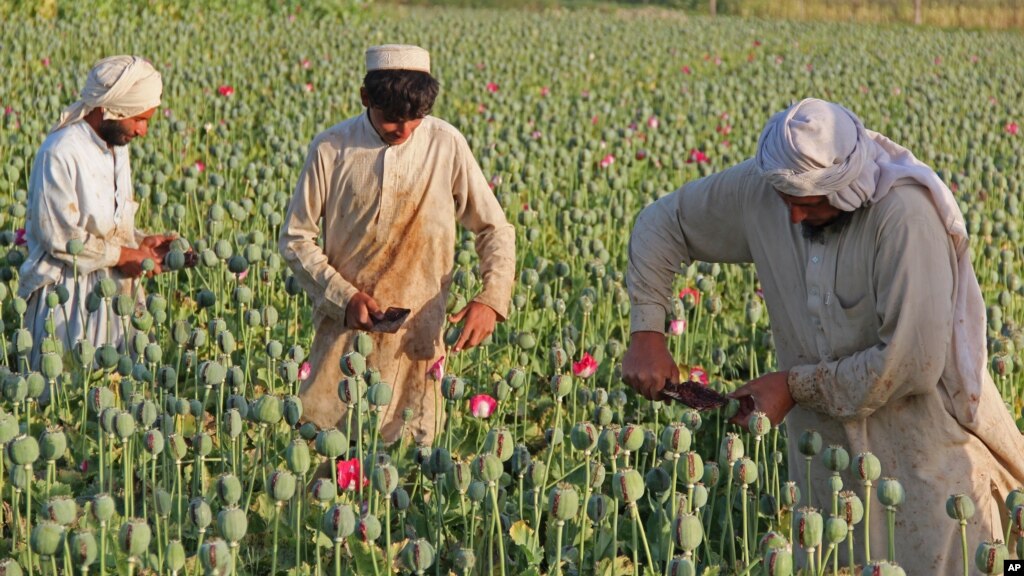
Afghan farmers collect raw opium as they work in a poppy field in Chaparhar district of Jalalabad, east of Kabul.

A survey reveals that the number of drug users in Afghanistan increased to three million last year from an estimated 1.6 million in 2012.

Afghan Health Minister Ferozuddin Feroz, while releasing findings of the U.S.-funded study in Kabul Tuesday, said it shows an alarming increase in drug users both in cities and rural areas, with children and women among them.

He said the number of drug users across Afghanistan stood at around 900,000 in 2005.

However, the survey has since documented the number of drug users increased to three million in 2014, the minister added, terming the trend “very worrying.”

Visiting Assistant Secretary of State for the Bureau of International Narcotics and Law Enforcement Affairs, William Brownfield, while sharing results of the research study, said it tells a “disturbing” story.

“Even more disturbing, the survey suggests that opioids, which lead to heroin and opium, the most disturbing of all the drugs, are the most prevalently used drugs in the rural area," Brownfield said, adding that children are also affected by this drug use.

The survey showed a national drug use rate of 11 percent, one of the highest in the world, suggesting one in every nine Afghans is a user of drugs.

"Drug use is an Afghan problem, an American problem and a problem for all the 195 countries represented in the United Nations," Brownfield said, underscoring the need for Afghans to tackle the issue as a national problem, and not a foreign problem.

The U.N. estimates Afghanistan grows about 80 percent of the world’s opium, which is used to produce highly addictive heroin. The war-torn country accounts for 90 percent of the world’s heroin supply
.

US Survey Says Afghan Drug Users Nearly Doubled Since 2012


Afghan farmers collect raw opium as they work in a poppy field in Chaparhar district of Jalalabad, east of Kabul.

A survey reveals that the number of drug users in Afghanistan increased to three million last year from an estimated 1.6 million in 2012.

Afghan Health Minister Ferozuddin Feroz, while releasing findings of the U.S.-funded study in Kabul Tuesday, said it shows an alarming increase in drug users both in cities and rural areas, with children and women among them.

He said the number of drug users across Afghanistan stood at around 900,000 in 2005.

However, the survey has since documented the number of drug users increased to three million in 2014, the minister added, terming the trend “very worrying.”

Visiting Assistant Secretary of State for the Bureau of International Narcotics and Law Enforcement Affairs, William Brownfield, while sharing results of the research study, said it tells a “disturbing” story.

“Even more disturbing, the survey suggests that opioids, which lead to heroin and opium, the most disturbing of all the drugs, are the most prevalently used drugs in the rural area," Brownfield said, adding that children are also affected by this drug use.

The survey showed a national drug use rate of 11 percent, one of the highest in the world, suggesting one in every nine Afghans is a user of drugs.

"Drug use is an Afghan problem, an American problem and a problem for all the 195 countries represented in the United Nations," Brownfield said, underscoring the need for Afghans to tackle the issue as a national problem, and not a foreign problem.

The U.N. estimates Afghanistan grows about 80 percent of the world’s opium, which is used to produce highly addictive heroin. The war-torn country accounts for 90 percent of the world’s heroin supply
.

Monday, May 11, 2015

ARAB WOMEN: HIGHLY EDUCATED, UNDEREMPLOYED


If you were asked to name countries where women vastly outnumber men in higher education, somewhere in the ultra-traditional Arab world would probably not be your first guess. And yet, in tiny Qatar, the oil-rich peninsula jutting off Saudi Arabia into the Persian Gulf, nearly seven times as many women as men are enrolled in university, one of the highest rates on the planet, according to the most recent figures compiled by the World Bank.

In fact, Maysa Jalbout, a fellow at the Brookings Institution’s Center for Universal Education, calculated recently that across the Arab world, women slightly outnumber men in tertiary education, with
a female-to-male enrollment ratio of 108 percent.

Surprisingly, it’s not a brand-new trend. Paolo Verme, a World Bank expert on the Middle East and North Africa, tells OZY that women there have made “huge gains” in the last decade or so in obtaining secondary and tertiary education. Fertility rates have also gone down rapidly across the region in the 21st century. And GDP growth has been on the rise. These are all prerequisites for women entering the workplace, at least based on what economists have found from studying other countries that now have high levels of female employment. So if all of this is happening in Arab countries, why are there still so few women working there?

As Jalbout points out, “Three out of four Arab women remain outside the labor force” — the lowest in the world. That’s true whether they’re college graduates or relatively uneducated. In fact, Verme and two colleagues found that in Morocco, the likelihood of women having a job went down with a high school-level education. He thinks there are a couple different factors at play.

The first is economic — the economies in the region may be growing, but not in the sectors most likely to employ women, like services and light manufacturing. And then there are the social norms. Verme has found that women in the region may get jobs early on, but exit the labor force en masse around the age of 25, aka average marriage age, regardless of whether or not they have children then. Family structures, still quite traditional, have a lot to do with it, says Mayyada Abu-Jaber, founder of the Jordan-based education NGO The World of Letters. In her work conducting youth employment-training programs, she found that more than half of female participants would decline the jobs offered upon completion. Deciding to work was a “collective decision of the family,” she found, and most families decide the vocational job opportunities “are not desirable for women.”

And while norms have shifted when it comes to the value of educating girls, they’ve not yet hit the women’s lib end of the spectrum. Education, notes Abu-Jabber, is now “very important for women” in Jordan, but not as a “transition for the workplace as much as it is becoming more desirable for marriage.” That helps explain why women with secondary education are less likely to work — they’re more likely to marry an educated man with a job that can support them both.

Verme cautions against concluding this all goes back to Muslim society. Look at the high female employment in places like Indonesia or Malaysia, which are majority Muslim. She says gender norms and social structure issues are important to the extent that the economy is weak. “I’m convinced if a country like Morocco was really able to compete in light manufacturing globally, all these other constraints would progressively disappear.”


Top Image Source: Loizeau/CC


OZY AUTHOR EMILY CADEI

Emily covers government, world affairs, business and sports for OZY. California-bred and D.C.-based, she's reported from four of the world's seven continents — still waiting for a byline from South America, Australia and Antarctica!

ARAB WOMEN: HIGHLY EDUCATED, UNDEREMPLOYED


If you were asked to name countries where women vastly outnumber men in higher education, somewhere in the ultra-traditional Arab world would probably not be your first guess. And yet, in tiny Qatar, the oil-rich peninsula jutting off Saudi Arabia into the Persian Gulf, nearly seven times as many women as men are enrolled in university, one of the highest rates on the planet, according to the most recent figures compiled by the World Bank.

In fact, Maysa Jalbout, a fellow at the Brookings Institution’s Center for Universal Education, calculated recently that across the Arab world, women slightly outnumber men in tertiary education, with
a female-to-male enrollment ratio of 108 percent.

Surprisingly, it’s not a brand-new trend. Paolo Verme, a World Bank expert on the Middle East and North Africa, tells OZY that women there have made “huge gains” in the last decade or so in obtaining secondary and tertiary education. Fertility rates have also gone down rapidly across the region in the 21st century. And GDP growth has been on the rise. These are all prerequisites for women entering the workplace, at least based on what economists have found from studying other countries that now have high levels of female employment. So if all of this is happening in Arab countries, why are there still so few women working there?

As Jalbout points out, “Three out of four Arab women remain outside the labor force” — the lowest in the world. That’s true whether they’re college graduates or relatively uneducated. In fact, Verme and two colleagues found that in Morocco, the likelihood of women having a job went down with a high school-level education. He thinks there are a couple different factors at play.

The first is economic — the economies in the region may be growing, but not in the sectors most likely to employ women, like services and light manufacturing. And then there are the social norms. Verme has found that women in the region may get jobs early on, but exit the labor force en masse around the age of 25, aka average marriage age, regardless of whether or not they have children then. Family structures, still quite traditional, have a lot to do with it, says Mayyada Abu-Jaber, founder of the Jordan-based education NGO The World of Letters. In her work conducting youth employment-training programs, she found that more than half of female participants would decline the jobs offered upon completion. Deciding to work was a “collective decision of the family,” she found, and most families decide the vocational job opportunities “are not desirable for women.”

And while norms have shifted when it comes to the value of educating girls, they’ve not yet hit the women’s lib end of the spectrum. Education, notes Abu-Jabber, is now “very important for women” in Jordan, but not as a “transition for the workplace as much as it is becoming more desirable for marriage.” That helps explain why women with secondary education are less likely to work — they’re more likely to marry an educated man with a job that can support them both.

Verme cautions against concluding this all goes back to Muslim society. Look at the high female employment in places like Indonesia or Malaysia, which are majority Muslim. She says gender norms and social structure issues are important to the extent that the economy is weak. “I’m convinced if a country like Morocco was really able to compete in light manufacturing globally, all these other constraints would progressively disappear.”


Top Image Source: Loizeau/CC


OZY AUTHOR EMILY CADEI

Emily covers government, world affairs, business and sports for OZY. California-bred and D.C.-based, she's reported from four of the world's seven continents — still waiting for a byline from South America, Australia and Antarctica!

SELFAA is ready to come in 2026